Pages

Saturday, September 12, 2015

2015: Year of Soil, Part I

Round Up sprayed on "weeds"
by one of our neighbors early this past Spring.
For the first time in modern history, an entire year has been dedicated to soil. 2015 is
none too soon in my view. When I see the desecration from Round Up and feel the
loss of life of the soil and all its inhabitants, my whole BEing is filled with grief.


The 68th United Nations General Assembly has declared 2015 the 
International Year of the Soils. And not a minute too soon,
 if you put any stock in Franklin D. Roosevelt’s 1937 warning:
 “The nation that destroys its soil destroys itself.”


For decades, we’ve been poisoning our soils with chemical fertilizers and pesticides.
 We’ve been overgrazing and overfarming our soil to the point that 
what were once prairies and grasslands teeming with life, 
are now lifeless dust fields.

     from Organic Bytes weekly e-newsletter

In the week past I attended one day of a two day conference in Richmond, California: Soil Not Oil (the title originated from Dr. Vandana Shiva's book Soil Not Oil: Environmental Justice in an Age of Climate Change). Those of you living in the Bay Area are well aware that Chevron has a huge refinery that periodically spews toxins into the air threatening the health and well being of Richmond's inhabitants. So, in my humble opinion, it was no accident that Richmond was chosen for this awesomely stellar conference and its mayor gave the welcoming address.

Before my life changing illness, conferences, lectures and such were common places for me to accumulate information. Once the rooting process at MuRefuge began my attention shifted to listening to the ancient knowing of the land and its inhabitants. This conference spoke to me and I am ever grateful to have listened. The basic message of the day was that global capitalism, practicing extraction from our planet to pour dollars into investors pockets and patriarchal dominance, is no longer viable. Regeneration* was the "word of the day" so to speak. 

     *"Regenerate: to give fresh life or vigor to; to reorganize; to recreate the

      the moral nature; to cause to be born again" New Webster's Dictionary, 1997

The myths that capitalism wants us to believe are now repeatedly refuted with hard science and logical approach: the land tilled (raped) by agribusiness grows little food to feed the world. This land is used to raised crops for biofuel or to feed animals, mostly cattle, in feed lots. Growing nontoxic healthy food is a solution to climate change. Not tilling the soil 
and not using manufactured fertilizers nor soil amendments, not using herbicides nor pesticides (oh my gosh how those practices would undermine agribusiness capitalism!) is the foundation for regeneration of the soil. Research has repeatedly been done to demonstrate that tilling the soil is detrimental to its maintaining its vibrant, dynamic population of worms, insects and microscopic organisms that not only absorb carbon but feeds the plants living in undisturbed soil as well. Growing food on the present amount of land presently farmed world wide is enough to feed not only the present population but the one predicted for the future IF regenerative practices replace the capitalist ones so widely now used.

Soil carbon restoration can be accomplished with methodical practices, and with many of us participating we can make a difference in climate change. Each one of us have the choice whether to support in our daily lives the present path to our extinction OR alter our beliefs, attitudes and habits and get on board with regeneration of the soil. 

The action steps printed below have been copied from the Northeast Organic Farming Association/Massachusetts Chapter


How can you take action in your own life to restore carbon to the soil and help rebuild the marvelous system that nature has put in place to renew our atmosphere?
Below are just a few of meaningful action steps for farmers, gardeners and homeowners, landscape managers, consumers and businesses, activists and educators, and policy makers to take. We will be editing and building on this list regularly, so check back often.
Farmers
  • Plant nitrogen fixing cover crops and living row paths.
  • Incorporate no-till or shallow till practices.
  • Recycle biomass with livestock (grazers, browsers, compost to poultry).
  • Replace pesticides and fungicides with diverse beneficial organisms.
  • Incorporate perennials or pasture cropping into your farm plan.
Gardener/Homeowner
  • Plant your lawn with diverse species, including deep rooted grasses and nitrogen fixing species like clover.
White clover growing between all our gopher proof raised vegetable beds
and our Tootsie Rolls (the 2 youngest female
Indian Runners) who by the way are now
producing daily an egg each. 
  • Mow, cut back, and/or heavily mulch over weeds instead of pulling.
  • Incorporate multi-layer, perennial, diverse plantings into your yard.
  • Compost, rather than burn, your yard waste.
  • Plant nitrogen fixing cover crops and living row paths.
Landscape Manager
  • Emphasize perennials in plantings and fill in gaps with annuals.
Spring flower annual natives growing amicably with native
Nodding Needlegrass (Nassella cernua) beneath one of my favorite trees the
Black Locust (Robinia pseudoacacia) which fixes nitrogen and is a native to the
Eastern U.S. but has naturalized in California.

  • Incorporate nitrogen fixing trees and perennials into the landscape.
  • Minimize the use of pavement and unproductive mulch.
  • Maintain diverse forested buffers and perimeters (can be productive).
  • Mow, cut back, and/or heavily mulch over weeds instead of pulling.
Consumer, Investor, Funder or Business
  • Purchase food from farmers that use regenerative and organic practices.
  • Stop buying from/supporting large scale, conventionally grown soy, corn, canola and cotton products which use synthetic nitrogen and persistent herbicides, contributing to massive soil loss every year.
  • Compost your kitchen waste.
  • Consume only 100% grass-fed and pasture raised meats, looking for farmers and ranchers prioritizing soil building.
  • Invest your food dollars in local farmers building soil, invest your climate action donations and advocacy into reforestation and reversing desertification (rehydrating the land) locally and globally.
Activist/Educator
  • Advocate against factory animal operations and for properly managed grass and pasture based farming.
  • Support replanting your local environment, support diverse meadows and deep rooted grass landscapes
  • Get to know diverse plants and biodiverse ecosystems in your region.
  • Invest your climate action donations and advocacy into reforestation and reversing desertification (rehydrating the land) locally and globally.
  • Study soil microbe biodiversity and support composting everywhere.
Policy Maker
  • Rule out synthetic nitrogen fertilizers on athletic fields, institutional and public park lands.
  • Prioritize climate funding for carbon farmers and ecosystem restoration.
  • Align local building codes with biodiversity and habitat regeneration and protection.
  • Emphasize development projects that regenerate, preserve, and do not destroy soil ecosystems.
  • Prioritize green infrastructure for coastal and inland flood management.


Did any of you view 20/20 last week? David Muir was at the Vatican with the Pope who then communicated with people gathered in 3 U.S. cities (Los Angeles; McAllen, Texas; and Chicago). I was brought to tears as the Pope opened his heart to these people telling their stories. Pope Francis is an beatific  amazing BEing; an exemplar for each of us whether Catholic or not.
"Where profits alone count, there can be no thinking about the rhythms of nature, 
its phases of decay and regeneration, or the complexity of ecosystems 
which may be gravely upset by human intervention . . . .
It is not enough to balance, in the medium term, the protection
of nature with financial gain, or the preservation
of the environment with progress.
Halfway measures simply delay the inevitable disaster."
Pope Francis, Papal Encyclical "Laudato Si," June 18, 2015

As we each consider how we each may contribute to this exciting life giving process of restoration, may we

Thursday, August 27, 2015

Lush

A few days past a visitor commented on MuRefuge looking "lush." MuRefuge's native plants are either in estivation, aka dormant, or headed to that state, so the description was rather a surprise. Then sitting with the exchange, not a surprise at all if one is in tune with the vibrant energetic matrix that composes MuRefuge.


LUSH, for sure!
The Siberian crabapple tree provided a bumper crop this year.
Several days ago some 20 pounds were harvested of which
about 5 were selected for the compost bin.

Having been unsatisfied with previous pickled Crabapple recipes I have tried, this season I decided to create my own recipe. Of course, the verdict on this recipe will not be in until these pickles have set in the pantry for several months for the flavors to maximally develop. So here's the recipe:

1/2 pound of Crabapples makes approximately 1 pint of pickles. This recipe is for 6 pounds.

  • 3 C. each of organic maple sugar and organic herb apple cider vinegar
  • 2 sticks of organic cinnamon 
  • 1 1/2 T. of each, all organic: allspice, cloves, coriander
Combine and bring to a boil.
Cook one layer of Crabapples at a time for 5", no more than 6" in the simmering liquid, remove from liquid and drop into sterilized pint glass jars (also sterilize the lids).  Strain liquid and pour liquid over the fruit. 


Add 1 organic cinnamon stick (use the 2 from the boiled liquid for 2 of the jars) and 1 organic whole cardamon seed to each jar. Divide the strained spices equally among the six pint jars filled with Crabapples and liquid. Steam process for 20".


Allow processed jars to completely cool before labeling and storing in a cool, dark place. The pantry in our Great Room is just perfect for storing canned goods.

SIGHTINGS:
Wandering out to veggie garden to freshen the ducks water in their two stainless steel bowls, I found this not only dead but battered butterfly. 


Upon investigation its identification was revealed: Gulf Fritillary whose range use to be limited to the Southern United States. With gardeners planting this butterfly's caterpillar food, Passionflower, here in Northern California, as one of our neighbors has done, the range has expanded.

And now the Hessel Avenue area has its very own drone peeking into women's windows.
Two of our female neighbors have shared seeing a drone located just outside their windows. Needless to say, neither woman felt safe with this kind of invasion of their living space.

As we all adjust to the happenings of our new to the neighborhood inhabitants, may we


Thursday, July 30, 2015

Turning

Laying atop dormant bunch grasses at MuRefuge,
a stone purchased in December, 2014,
from the Georgia O'Keefe Museum, Santa Fe, NM,
Flowering Red Buckwheat
(Eriogonum grande var. rubescens)
According to the Celtic calendar August 1 is the third of the four seasonal cross quarter days. The ancient midsummer celebration of Lammas (old English for "loaf mass") honored the new harvest by baking bread. 

No matter what the calendar reflects, the season is turning here at MuRefuge earlier than "usual." For the past month to six weeks autumnal behavior abounds here with the crows congregating, as well as the deer, in the field South of her property line here in the West Sonoma County. The grasses on the hill sides are golden brown. The tinder dry vegation is fueling a plethora of wildfires all around California. Cal FIre says the wildfire season has started several months earlier than "usual." Back here at MuRefuge the typically late flowering natives, planted to provide nectar for the butterflies migrating South, are already in full bloom.
California Aster 'Point Saint George' (Aster chilense)
California Goldenrod (Solidago californica)
Tom Stienstra, the Bay Area outdoor writer, recently published an article in the Sunday San Francisco Chronicle regaling the predictions wildlife make about our weather here along the West Coast. He gave many examples of fish and birds migration patterns that alert us
to the coming changes and suggests these are more predictive than the forecast made by meteorologists.

As we "take time to look" and experience the early turning of the seasons,  may we 


Saturday, July 25, 2015

Gardening

"Why do humans garden?" is a question I am asking myself since three members of the local Milo Baker Native Plant Society came to see MuRefuge as a possibility for inclusion in a 2016 native gardens tour. No word from any of them . . . nada. The lack of communication from these individuals and the organization has set the stage for an inner inquiry about the process of gardening in general. 

I grew up with a family garden that was grown to provide food for us not only fresh but preserved as well. My mom gardened as her mother did. 


My Grandma Haynes in her garden in Wesley, Iowa,
on July 26, 1967. The pole behind her held a very large martin house.
Her birthday was February 17, 1883 and she passed January 02, 1968.
So my gardening is informed by this history which is not a surprise. As those of you who have read the very first blog post know the gardening process here at MuRefuge expanded to include healing of not only myself but of the land as well. 


When I began stamping in the '90's,
this is one of the first I purchased.
I still use it on cards I make and
the reminder is still poingnant.
When the house was built on this three quarters of an acre, the dirt was scraped away leaving not very healthy soil. My very early childhood was less than idyllic and my early adult life was fueled by adrenaline. So arriving at MuRefuge very ill with an autoimmune disease uncurable by Western medicine and the land in a degraded and abused state, my "gardening practice" became one of restoration. In that process I found myself aware of energy flow . . . of my own, of the land and of the other BEings about.

The garden evolved as did my healing, both becoming alive and vibrant. Many of the original plants brought to MuRefuge did not survive. The plants taught me what wanted to grow here and others demonstrated a desire to live here but in a different spot, microclimate if you will. So I became aware of the microclimates of this very small piece of land through a cellular process aka body based. I learned the effects of wind, water and soil composition. I learned of the naturalizing process food plants go through: if you bring seeds from a distance land those plants through their seeds will acclimate.Pimento peppers which originate from a much hotter climate than here where the marine influence provides a cooler one was my first teacher in this realm of learning. Year after year I harvested the earliest ripening pimento pepper and saved the seeds to plant the following year. This remains my practice so we now have lush delicious thick walled sweet pepper to enjoy cooked and uncooked in a variety of dishes as well as preserved for enjoyable Winter eating. When my mom visited one time in the past when these luscious fruits were ripe, she ate so many she actually became ill developing a severe case of diarrhea.

Native plants abound here at MuRefuge. Most of the species were chosen to provide food for all the other BEings who also call this place home. The many different varieties of manzanita flower continuously over the cooler months, providing nectar for the Anna hummingbirds who are year round residents.


The "hedgerow" along the South property line is planted in the wettest part of MuRefuge's land.The various bushes provide berries for the berry eating birds. My favorite is the Twinberry bush which is a native honeysuckle. The tubular double flower provides nectar for hummingbirds and the berries provides food, too.


 The Blue birds love the black ripe berries. 
We have watched a mother Blue bird pluck a ripe berry
and feed it to her open mouthed offspring.
The vegetation planted here at MuRefuge and now flourishing provides an energetic web that one who is sensitive to qi can feel as one walks through the garden. As I have had many tours here at MuRefuge, I am continually amazed by the various responses from those who visit. It is obvious to me that some experience the healing web, aka wild matrix of qi. The three women who visited from the Native Plant Society did not seem to be aware of the web or perhaps did not find it healing or maybe they were looking for a garden with something other than what MuRefuge offered? Mu Refuge is a wild garden by design with not much tidiness nor beauty if one views it from the traditional horticultural perspective arising out of the historical European gardens by those who have studied this gardening style or contain human DNA from those ancestors.

Gardening is a personal activity informed as I alluded to earlier in regards to my gardening roots. Reading two awesome gardening books has offered me an opportunity to see into the lives of two exordinary women each living in not only different centuries but different parts of this country as well. Here is a bit about each of these two books.


The photograph taken by Gilbert L. Wilson of Sioux Woman,
Buffalo Bird Woman's daughter-in-law, is on the cover of
Buffalo Bird Woman's Garden: Agriculture of the Hidatsa Indians.
Anthropologist Gilbert L. Wilson, in meticulous detail, transcribed
the knowledge Buffalo Bird Woman, born in 1839, generously gave to him.
From the introduction by Jeffery R. Hanson: "Following an annual round, Buffalo Bird woman describes field care and preparation, planting, harvesting  processing, and storing of vegetables. In addition, she provides recipes for cooking traditional Hidatsa dishes and recounts songs and ceremonies that were essential to a good harvest. Here first person narrative provides today's gardener with a guide to an agricultural method free from fertilizers, pesticides, and herbicides." There are illustrative drawings and photographs.
For me this book was powerful and instructive about living simply and how hard those Hidatsa, a Siouana linguistic tribe located in now North Dakota along the upper Missouri RIver, women worked growing food in a place near Minot, where we all know it can get very cold in the Winter (and hot, I might add, in the Summer). This area is now a huge reservoir. Buffalo Bird Woman shares her tribe's origin stories (Hidatsa means "willows") including those of the corn, squash and beans seeds. And from a different perspective, these seeds from lands way South in Mexico, and perhaps further in South American, were brought North and naturalized by a process similar to what I have done with the pimento peppers here at MuRefuge.


Carol Deppe has been gardening in Corvallis, Oregon, since 1979.
She has a BS in zoology from the University of Florida and a PhD in
biology from Harvard University. She is an "Oregon plant breeder" who
"specializes in developing public domain crops for organic growing
conditions, sustainable agriculture, and human survival."

I must first say I loved this book, especially since she raises ducks for egg production and for pest control as do I. And I was struck by the similarity of how her book is organized in much the same way as Buffalo Bird Woman's. Of course, much of the updated information and knowledge is informed by science: what we now know about plants' habits, for example, and about cross pollination, and about plants needs of healthy soil and crop rotation. Her gardening stories are precious and her sharing of resources immensely useful.

As we go about our gardening, in whatever manner we do so, may we

Thursday, July 2, 2015

Simple not Easy

While I was sitting one morning this week past, a mom fox ran along the far side of our South fence carrying a rabbit in her mouth perhaps to her den to feed her offspring.

A family of six Black headed Grosbeaks are frequenting our bird feeders each morning. Titmice, Nuthatches, Mockingbirds, Gold Finches and, of course, the rowdy Blue Jays all get a "bite to eat" and sip of water. Chickadees are obviously nesting here at MuRefuge somewhere not yet identified or at the very least nearby. The seasonal changing of the bird population here at MuRefuge reminds its human BEing inhabitants of the natural rhythm called wu wei in the Taoist tradition. Literally wu wei means non action or non doing. A practicing Taoist describes this term: "cultivation of a state of being in which our actions are quite effortlessly in alignment with the ebb and flow of the elemental cycles of the natural world. . . . it is a kind of 'going with the flow' that is characterized by great ease and awake-ness, in which without even trying, we're able to respond perfectly to whatever situation arises."

Each day situations present themselves during our day offering us an opportunity to awaken fully and BE with wu wei, which is simple not easy.  Each of us can chose to BE awake, using the opportunity or not. I am reminded of the process by an adage from my high school band instructor: "practice makes perfect only if you practice perfectly." Now for this One who often perseverates upon "perfection" the meaning takes on a whole different perspective when One considers Tao Perfection, aka wu wei, rather than mere human perfection.

The Pipevine Swallowtail butterfly and the Monarch butterfly practice Tao Perfection each time one of these butterflies lays her eggs. Each choses the particular plant species which will nourish and protect the emerging caterpillar which evolves into a beautiful winged creature, the butterfly. This is the simple and perfect practice of species survival. It is not easy, this process from egg to caterpillar to butterfly. Nor is it easy for these BEings to negotiate all the obstacles presented to them (such as Roundup which is the human easy approach to ridding their property of weeds).


Pipevine caterpillars of various ages munching away at the Californina Pipevine's leaves.
A tiny Monarch caterpillar gobbling up a local milkweed leaf.
Rejoice! There are many holes in the milkweed leaves.
Unfortunately the Monarch caterpillars are not as numerous as the Pipevine caterpillars.
Simple not easy. I am a baseball fan, to be more exact, an Oakland Athletics'  baseball fan. Simple not easy adjusting to a low payroll team that trades their prime players because they cannot pay them what the high payroll teams will pay them. This is the natural cycle of the Oakland A's: members of the team in their prime leave every few seasons. This season has been instructive to me watching these young baseball players honing their craft. Practice makes perfect only if you practice perfectly. The young shortstop now playing for the A's is hard working; everyone who has know this young man since boyhood agrees. He shows up early and stays late learning and practicing. Oops, practicing but not perfect practicing until the stellar infield coach was hired after the season started. My oh my, how evident the perfect practice of going with the flow is when one watches this shortstop's footwork and movements on the infield during a baseball game now as compared to the beginning of this baseball season. Yes, he still makes errors. However, the errors are not from imperfect practice but rather from honing his craft and establishing new body memories of how to play shortstop. Simple not easy.

Another reminder for me of simple not easy: our going on nine years old yellow billed female fawn and white duck has a tumor growing at the junction of her right wing. She is evidence that that life of a duck begins with birth or in her case hatching and flows unimpeded towards death. 
The morning routine of the four oldest female Indian Runner ducks heading for their pond, aka old bathtub.
The top duck in the picture is the female with the tumor beneath her right wing.

Here she is beginning her day after leaving the her deluxe duckhouse one recent morning past.
She stretches out and flaps her wings, even though the right one no longer flaps as it once did.
She is the one on the far right beneath the flowering currant bush.
Fresh green lettuce for breakfast is enjoyed by all.
On the left is the duckhouse where trays with the organic soy free laying pellets
will soon be set for this morning ravenous flock.

She is okay with her process; even appearing content BEing with wu wei. She clearly enjoys her flock, MuRefuge, and us "kind" humans who provide her a safe environment in which she is living her life. I realize I want to make her process easy. Surely there is something I can do to make it easy. Then I am reminded how our doing something was for our dog, Rose. (*click and you'll have a link to Rose's story on this blog) Her leg was amputated for bone cancer. Of course, Rose's short time with us was a simple lesson in not easy. 

The natural process of BEing in physical form has a simple flow. Doing is easy and can provide one with a sense of "taking care of a situation" and keeps one busy with a flurry of activity providing an illusion of importance. Simple, on the other hand, takes "practicing Perfectly" this ageless Tao, "Perfect Knowing" that when a spirit, aka soul, inhabits a physical form the natural flow is birth or beginning, a middle, and an end or death. This marvelous creature, the old yellow billed female fawn and white duck, is reminding me of the temporariness of physical form, aka body, and how simple it is to BE with this natural process.

As we flow in the Taoist wu wei, may we


Saturday, June 13, 2015

A Glorious Sighting

Monarch butterflies used to visit MuRefuge in the Summer; of late not so much. Fall migration seems to bring Monarchs passing through routinely. However, while I was at the O.Co Coliseum this Thursday past enjoying an A's game, Dwight caught this glorious sighting on camera. 


And then he looked closer at the native milkweed and saw eggs the Monarch butterflies had deposited on a number of the plants' leaves.


Look closely and you can see the little single, white dots, eggs.
It was pretty windy so she chose the
shortest milkweed plants
to lay her eggs.

Since Dwight's glorious sighting, while working outside here at MuRefuge, I too have been blessed with similar sightings. Monarchs are such regal BEings and gifts to each of who are fortunate enough to see them. May we lament (and perhaps change some of our practices?) the rapidly dwindling population here in our Northern Hemisphere.

At this glorious sighting caught on camera, feel free to


Monday, June 8, 2015

Almost the Height of Summer

The Summer Solstice, the height of Summer, is quickly approaching, although it seems Spring has just arrived at MuRefuge. Here the temperatures have been subnormal for this time of the year. There has been very little sunshine until the past few days.


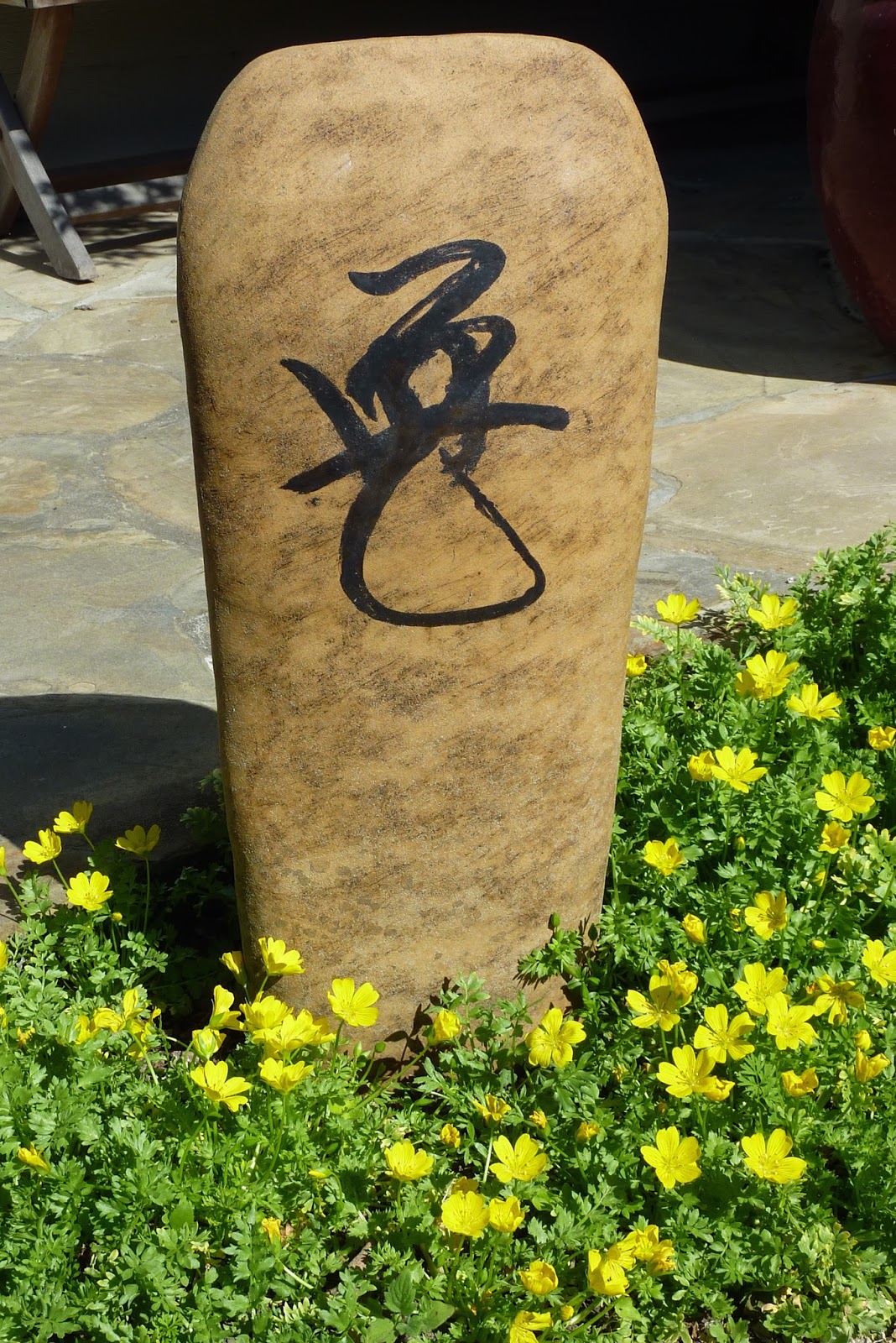
Point Reyes Meadowfoam surrounding our
MuRefuge sculpture, which Dwight made some while ago,
located between our driveway and front entryway.
"Mu" means "all or nothing" in Japanese.
A perfect name for our 3/4 acre here in West Sonoma County.
Point Reyes Meadowfoam up close and personal.
The seeds were gathered by and purchased from
Larner Seeds in Bolinas, California.
There has not been the usual several weeks of record breaking heat to finish off the Cascadia pea plant which prefers coolish weather. This variety I grow for both the pods and peas as well as the "shoots" for salads. This variety does produce longer in warmer weather than most AND is extremely tasty as peas and pods.


Cascadia peas producing the superior flavor pods, shelled peas and shoots.

Pea pod,s pea shoots, French Breakfast radishes, green onions, chervil salad
with kefir milk, olive oil and chives dressing. A delish! light evening meal.

THREE SISTER UPDATE

For a girl raised in Iowa, the land of corn growing, I found out I am ignorant when it comes to knowing about corn. My knowledge seemed to be totally limited to "field corn" which when I was growing up was not tainted with GMOs or hybridized to be "sweet". Corn was just corn. Well, in my discovery learning I found out that corn, Zea mays, of
Three Sisters, is categorized into
  • Sweet corn, 
  • Flour corn with kernels relatively soft for grinding into a fine flour for baking, 
  • Dent corn with kernels that have a floury center surrounded by flinty edges which is traditionally used for hominy and masa for making tortillas and tamales, 
  • Flint corn which is high protein and contains a hard and translucent kernel for grinding into polenta and meal rather than flour, 
  • Popcorn which of course we all know how to use.
In both Robin Wall Kimmerer's book Braiding Sweetgrass and Carol Deppe's The Resilient Gardener information about planting Three Sisters was gleaned. The microclimate and the gardening space, as well as my gardening knowledge, was reason for adaptation in planting corn, beans and squash here at MuRefuge. AND this new to me project, I readily admit, certainly does push my One (Enneagram type) button of perfection, not Divine perfection but rather the human, individual idea of perfection. The realization that Three Sisters plannings historically thrived and failed is a comforting thought; soothing my fear of not doing this perfectly.

Hopi Blue Flour corn growing in the warmest location here at MuRefuge.

Anasazi corn growing in one of the longer basalt block veggie beds.
Note in the back right of the corn a lemon cucumber has been planted.

This past week Fortex French fillet beans, soaked overnight in comfrey tea, were planted around the corn which has been slow to grow with the cool weather here at MuRefuge. Once the beans are up and growing to twine about the corn stalks, both Summer and Winter squash seeds will be planted. The big question is whether the weather will be favorable to all these plants companionably growing together.

RECENT SIGHTINGS

In the last couple of weeks a Red shouldered Hawk has been visiting regularly, swooping through the trees in search of food.  A few days ago Dwight saw the hawk plunge to the ground, capture a gopher, and fly off to enjoy a meal.  Usually it has been sitting up in the Oregon Oaks behind our house looking down around the bird feeder for the small birds that are its favorite food.  As the hawk arrived the birds quickly disappear and all is quiet until the hawk flies elsewhere to hunt again.


The Red shouldered Hawk waiting patiently for lunch.

Last season there was a plethora of baby deer, both twins and single babies. One of those sets of twins are boys with antlers visible with almost daily growth. This season in the megadrought only one pair birthed several months ago and just a few weeks ago a single baby deer. The wildlife seem to be attuned to the change in rainfall since it affects their food supply.

Baby turkeys in abundance in most years past are also in short supply this year. Three moms bring their brood down to forage beneath the bird feeders. There are only six total this season. And how Shasta loves to chase them to see them fligh up into the trees, bushes and atop the house. We have pretty much trained her not to do that to the ducks who call MuRefuge home, too.

As each of us express our gratitude to Mother Earth may we