Pages

Showing posts with label corn. Show all posts

Saturday, July 25, 2015

Gardening

"Why do humans garden?" is a question I am asking myself since three members of the local Milo Baker Native Plant Society came to see MuRefuge as a possibility for inclusion in a 2016 native gardens tour. No word from any of them . . . nada. The lack of communication from these individuals and the organization has set the stage for an inner inquiry about the process of gardening in general. 

I grew up with a family garden that was grown to provide food for us not only fresh but preserved as well. My mom gardened as her mother did. 


My Grandma Haynes in her garden in Wesley, Iowa,
on July 26, 1967. The pole behind her held a very large martin house.
Her birthday was February 17, 1883 and she passed January 02, 1968.
So my gardening is informed by this history which is not a surprise. As those of you who have read the very first blog post know the gardening process here at MuRefuge expanded to include healing of not only myself but of the land as well. 


When I began stamping in the '90's,
this is one of the first I purchased.
I still use it on cards I make and
the reminder is still poingnant.
When the house was built on this three quarters of an acre, the dirt was scraped away leaving not very healthy soil. My very early childhood was less than idyllic and my early adult life was fueled by adrenaline. So arriving at MuRefuge very ill with an autoimmune disease uncurable by Western medicine and the land in a degraded and abused state, my "gardening practice" became one of restoration. In that process I found myself aware of energy flow . . . of my own, of the land and of the other BEings about.

The garden evolved as did my healing, both becoming alive and vibrant. Many of the original plants brought to MuRefuge did not survive. The plants taught me what wanted to grow here and others demonstrated a desire to live here but in a different spot, microclimate if you will. So I became aware of the microclimates of this very small piece of land through a cellular process aka body based. I learned the effects of wind, water and soil composition. I learned of the naturalizing process food plants go through: if you bring seeds from a distance land those plants through their seeds will acclimate.Pimento peppers which originate from a much hotter climate than here where the marine influence provides a cooler one was my first teacher in this realm of learning. Year after year I harvested the earliest ripening pimento pepper and saved the seeds to plant the following year. This remains my practice so we now have lush delicious thick walled sweet pepper to enjoy cooked and uncooked in a variety of dishes as well as preserved for enjoyable Winter eating. When my mom visited one time in the past when these luscious fruits were ripe, she ate so many she actually became ill developing a severe case of diarrhea.

Native plants abound here at MuRefuge. Most of the species were chosen to provide food for all the other BEings who also call this place home. The many different varieties of manzanita flower continuously over the cooler months, providing nectar for the Anna hummingbirds who are year round residents.


The "hedgerow" along the South property line is planted in the wettest part of MuRefuge's land.The various bushes provide berries for the berry eating birds. My favorite is the Twinberry bush which is a native honeysuckle. The tubular double flower provides nectar for hummingbirds and the berries provides food, too.


 The Blue birds love the black ripe berries. 
We have watched a mother Blue bird pluck a ripe berry
and feed it to her open mouthed offspring.
The vegetation planted here at MuRefuge and now flourishing provides an energetic web that one who is sensitive to qi can feel as one walks through the garden. As I have had many tours here at MuRefuge, I am continually amazed by the various responses from those who visit. It is obvious to me that some experience the healing web, aka wild matrix of qi. The three women who visited from the Native Plant Society did not seem to be aware of the web or perhaps did not find it healing or maybe they were looking for a garden with something other than what MuRefuge offered? Mu Refuge is a wild garden by design with not much tidiness nor beauty if one views it from the traditional horticultural perspective arising out of the historical European gardens by those who have studied this gardening style or contain human DNA from those ancestors.

Gardening is a personal activity informed as I alluded to earlier in regards to my gardening roots. Reading two awesome gardening books has offered me an opportunity to see into the lives of two exordinary women each living in not only different centuries but different parts of this country as well. Here is a bit about each of these two books.


The photograph taken by Gilbert L. Wilson of Sioux Woman,
Buffalo Bird Woman's daughter-in-law, is on the cover of
Buffalo Bird Woman's Garden: Agriculture of the Hidatsa Indians.
Anthropologist Gilbert L. Wilson, in meticulous detail, transcribed
the knowledge Buffalo Bird Woman, born in 1839, generously gave to him.
From the introduction by Jeffery R. Hanson: "Following an annual round, Buffalo Bird woman describes field care and preparation, planting, harvesting  processing, and storing of vegetables. In addition, she provides recipes for cooking traditional Hidatsa dishes and recounts songs and ceremonies that were essential to a good harvest. Here first person narrative provides today's gardener with a guide to an agricultural method free from fertilizers, pesticides, and herbicides." There are illustrative drawings and photographs.
For me this book was powerful and instructive about living simply and how hard those Hidatsa, a Siouana linguistic tribe located in now North Dakota along the upper Missouri RIver, women worked growing food in a place near Minot, where we all know it can get very cold in the Winter (and hot, I might add, in the Summer). This area is now a huge reservoir. Buffalo Bird Woman shares her tribe's origin stories (Hidatsa means "willows") including those of the corn, squash and beans seeds. And from a different perspective, these seeds from lands way South in Mexico, and perhaps further in South American, were brought North and naturalized by a process similar to what I have done with the pimento peppers here at MuRefuge.


Carol Deppe has been gardening in Corvallis, Oregon, since 1979.
She has a BS in zoology from the University of Florida and a PhD in
biology from Harvard University. She is an "Oregon plant breeder" who
"specializes in developing public domain crops for organic growing
conditions, sustainable agriculture, and human survival."

I must first say I loved this book, especially since she raises ducks for egg production and for pest control as do I. And I was struck by the similarity of how her book is organized in much the same way as Buffalo Bird Woman's. Of course, much of the updated information and knowledge is informed by science: what we now know about plants' habits, for example, and about cross pollination, and about plants needs of healthy soil and crop rotation. Her gardening stories are precious and her sharing of resources immensely useful.

As we go about our gardening, in whatever manner we do so, may we

Monday, November 3, 2014

The Three Sisters


A few weeks past I was blessed with the opportunity to join in celebration of women's indigenous knowledge. One of the Bioneers pre-conference intensives, "Three Sisters Farming: Indigenous women, plants, and foodways," happened at the Indian Valley Organic Farm and Garden, College of Marin in Novato, California. This historic workshop was presented by the Cultural Conservancy and Bioneers Indigenous Knowledge Program. 

I must admit right up front that what drew me to send in my money was Robin Kimmerer, author of Braiding Sweetgrass (2013) and Gathering Moss (2003), since I missed her at Point Reyes Bookstore. Her books touched my restorative gardener soul and native habitat heart. She did not disappoint with her reading of "The Three Sisters" from her latest book. She is such an awesome storyteller of what really matters.

You may wonder who are the Three Sisters?


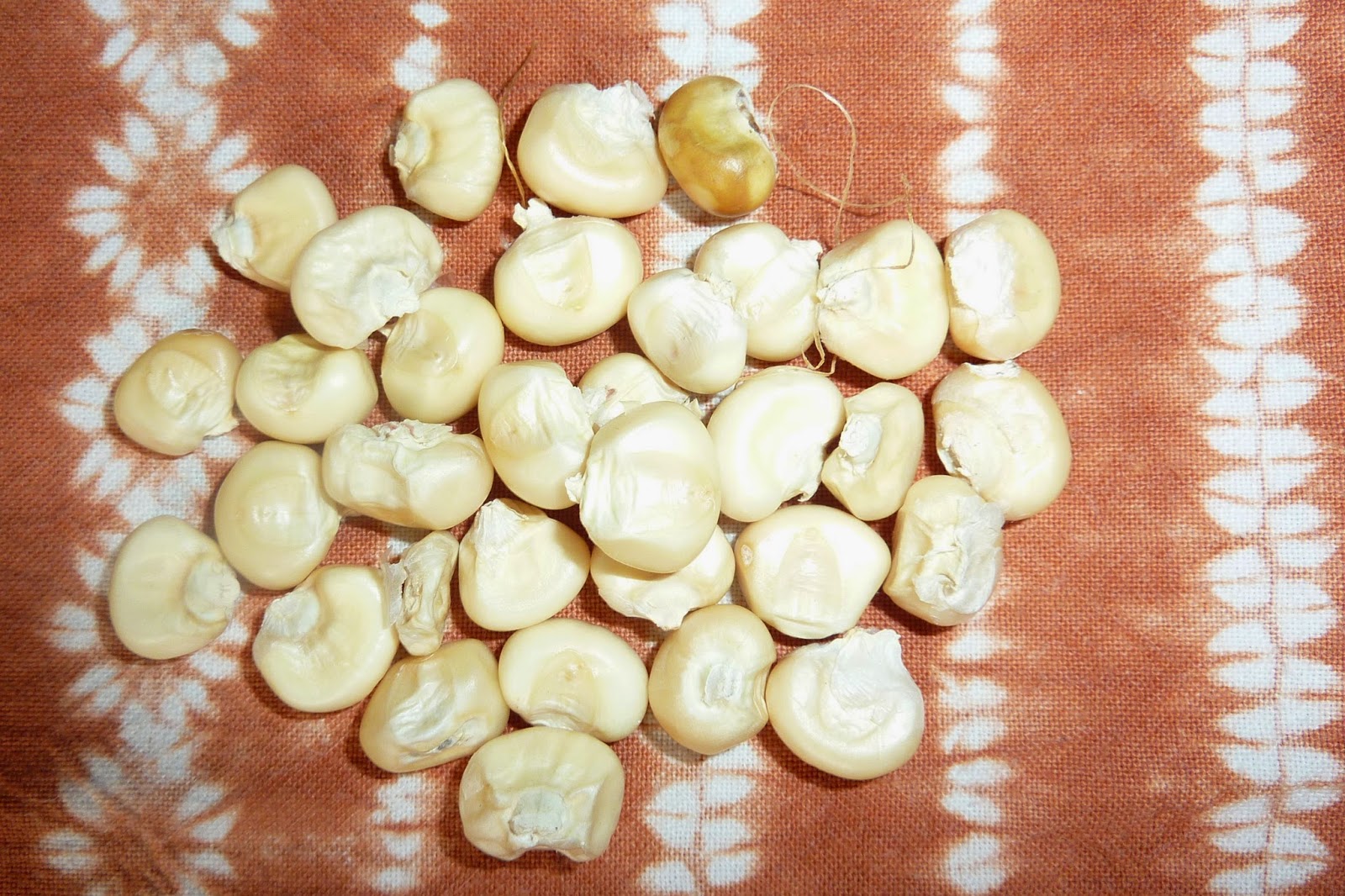
Corn, the ancient grain, ground for flour by natives peoples.
This is not our corn on the cob version,
rather it is harvested when the kernels are completely dry.
These are a few kernels from the actual corn we harvested at the garden in
Novato which was planted by Kaylene Bray's father earlier in the season.
In a mound 4 seeds of corn are planted in each of the four directions. Once these have sprouted and are a few inches tall, 4 beans (which we think of as pole beans; in this garden the beans planted were Scarlet Runner Beans) are planted in the NE, NW, SE, SW corners or in between the sprouted corn. Once the beans have sprouted and the corn is growing skyward, 4 squash (Navajo Hubbarb in this garden) or pumpkin seeds are planted on the downslope of the mound. 


"For millennia, from Mexico to Montana, women have mounded up the 
earth and laid these three seeds in the ground, all in the same 
square foot of soil. When the colonist on the Massachusetts shore 
first saw indigenous gardens, they inferred that the savages 
did not know how to farm. To their minds, a garden meant straight 
rows of single species, not a three dimensional sprawl of abundance. 
And yet they ate their fill and asked for more, and more again." from Braided Sweetgrass

Since Robin Kimmerer is not only a Citizen Potawatomi Nation member but a botanist as well, she goes on in "The Three Sisters"  chapter with great detail about how these three plants not only coexist but how they benefit one another as well. WOW! Indigenous companion planting, now that is just so exciting to me! 

There were a number of women who participated, each bringing a wonderful teaching from her indigenous place. And the experience in the garden, although it was planted in rows (even the tepary beans) except the three sisters, was full of energetic interconnectedness. Here I was introduced to tepary beans which I had not heard of, but having lived in Tucson, I was familiar with the Tohono O’odham who are growing them today. These native peoples, eating the American diet of fast food, suffer from an epidemic of diabetes and all its complications. They rediscovered this bean which had been a staple of their ancestors. The plant is unlike other bean plants in that it is able to soak up the monsoonal rains, store the water in its roots and meter the release so that the plant survives through the heat and dryness so often a part of the desert during the growing season. Researchers have found this bean rates low on the Glycemic Index. These native people relate that the way this bean controls insulin release merely mimics how the plant itself releases water. The native peoples returning to eating the way of their ancestors are finding diabetes diminishing in those returning to that way of eating.

Here's two of the women who spoke to me:

Roxanne Swentzell, founder of Flowering Tree Permaculture at her home in Santa Clara Pueblo, shared her video of her study in which her peoples returned to eating as her grandparents and great grandparents ate. Just like the Tohono O’odham found with the tepary bean, the three month long study described in the video showed a remarkable healing  of the participants. The weight loss varied among them from 25 to almost 50 pounds, laboratory values returning to "normal" limits, the return of vibrant energy for enjoying daily life, and as one of the youngsters discovered, "McDonald's is poison to my body." Roxanne shared that this way of eating is a diet rather "cultural preservation". She is also a talented sculptor and her work is showcased at the Tower Gallery. Dwight, a sculptor himself, has viewed much of her work on the web.

Sage LaPena, a Wintu and the Water Resource Coordinator at California'a Hopland Pomo Tribal EPA, shared a minuscule bit of her plant knowledge. Judith Larner writes in Gardening with a Wild Heart of Sage's learning and knowledge.  Her passion for bringing healing and wholeness to her native people through reconnection with ancient ways brought tears not only to my eyes but to many eyes in the audience gathered beneath the old oak tree.

Sage shared how the plants inform one who observes how to
use the plant. Take for example the yarrow above, how the leaves
look like arteries fanning out into arterioles. And from ancient timeright
up to the present the plant's ability to staunch bleeding is well known.
Sage talked about how the Chumash inhabiting the beaches and mountains
around Santa Barbara are now finding their White sage decimated by others gathering
this wonderful smudging plant. This plant is growing at MuRefuge.
As you consider planting the three sisters in your garden for sumptuous food, may you