Pages

Wednesday, February 17, 2016

California Pipevine

From Complete Garden Guide to the Native Perennials of California by Glenn Keator:

"Here is perhaps our most curious native vine. Roots penetrate deeply between rocks on brushy or wooded hillsides; stems wind their way around surrounding vegetation to reach light. Stems are covered with attractive, fuzzy narrowly heart-shaped leaves; flowers are often borne before new leaves appear at the end of winter. These are alway sure to catch attention — they are distinctly pipe-shaped, the sepals with three maroon-purple lobes at the opening to the 'pipe.' The rest of the floral envelope consists of brown and white stripes which surround and hide the stamens and pistil. Insects are fooled into entering the pipe, lose their orientation, and remain trapped until pollination is completed. Pipevine is capable of extending stems several feet in a season, but the new growth and leaves are normally lost in winter, to be replaced the following season. Cuttings and rooted sections are quite easy ways of propagating pipe-vine.

Since pipe-vine is more odd than beautiful, it might be displayed on its own trellis, rock wall, unsightly shrub, or simply up a small tree in the woodland garden. Since the pipe-vine swallowtail butterfly depends upon the leaves as food for its larvae, planting this species will attract these beautiful butterflies."

Louise Hallberg has almost single handedly assured all of us living here in Sonoma County of a plethora of Pipevine Swallowtail butterflies to enjoy. For many years she has led by example by planting and caring for this "curious native vine." We are so fortunate for her setting this example for gardeners who often plant this caterpillar food for the Pipevine Swallowtail butterfly, thus supporting its flourishing numbers when most other butterflies are nearing extinction since their caterpillar food plants are becoming scarcer or disappearing altogether.

The many California Pipevines growing here at MuRefuge are covered with the what I see as beautiful flowers, looking like none of the other early blooming natives perennials. Two Winters ago a start was planted just inside the gate by the garage. This is the primary gate used to enter and exit the fenced area of MuRefuge. So the thought was "wouldn't a California Pipevine be an attraction at this location?" The plant and its dependent butterfly have not disappointed! Caterpillars were abundant last Spring and Summer, and now the entire vine on its trellis is covered with flowers with nary a leaf yet to distract from this eye catching display.

The California Pipevine in full bloom
      The California Pipevine leaves that are the Pipevine Swallowtail caterpillar food.

Pipevine Swallowtail caterpillars in varying sizes munching away at the plant specific food.

The California Pipevine caterpillar

The California Pipevine seedpod

The Pipevine Swallowtail chrysalis

Freshly emerged Pipevine Swallowtail

May we honor diversity, support ecological gardening and


Wednesday, February 10, 2016

Mostly Natives Nursery and Other Awesome Sources

A gloriously cheerful Western Columbine flower in bloom to the delight of hummingbirds.
The feel of Spring pervades all of MuRefuge. The rains have stopped and the temperatures are rising well above average which is unsettling for all the BEings
here at MuRefuge. Undaunted I go forward with planting out the native grasses and perennial flowers started in late Fall of last year. The Western Columbines (Aquilegia formosa) have a home in the bed that previously belonged to St. John’s Wort which I grow for herbal medicine making. Since the sun does not shine on this bed all day, as it did before all the bushes and trees have grown, the plants were dug up and moved to a sunny spot. This is a great location for Western Columbines with some shade and some Summer water since this bed abuts the vegetable garden. They now surround the rhubarb plants, thus reaping protection against red spider. Did you know that rhubarb is one of “our oldest garden plants, which Marco Polo found growing in China centuries ago,” says Louise Riotte in her book Carrots Love Tomatoes: Secrets of Companion Planting for Successful Gardening?
The focus here at MuRefuge is a balanced, ecological "garden." Through experience of planting plants together (aka companion planting) this focus is fostered. Also, fostering balance and well BEing of plants, transplant shock was addressed early on, not only in MuRefuge's evolution but in mine as well. Originally I purchased a variety of cell sizes of Todd planters from Harmony Farm Supply. When this local purveyor no longer carried them, I found Peaceful Valley Farm Supply in Grass Valley carried them. By this time I had honed my seed growing and preferred the 4x8 cell size which I now use exclusively. The original Todd planters purchased are still in use, since with careful handling and care they remain useful.
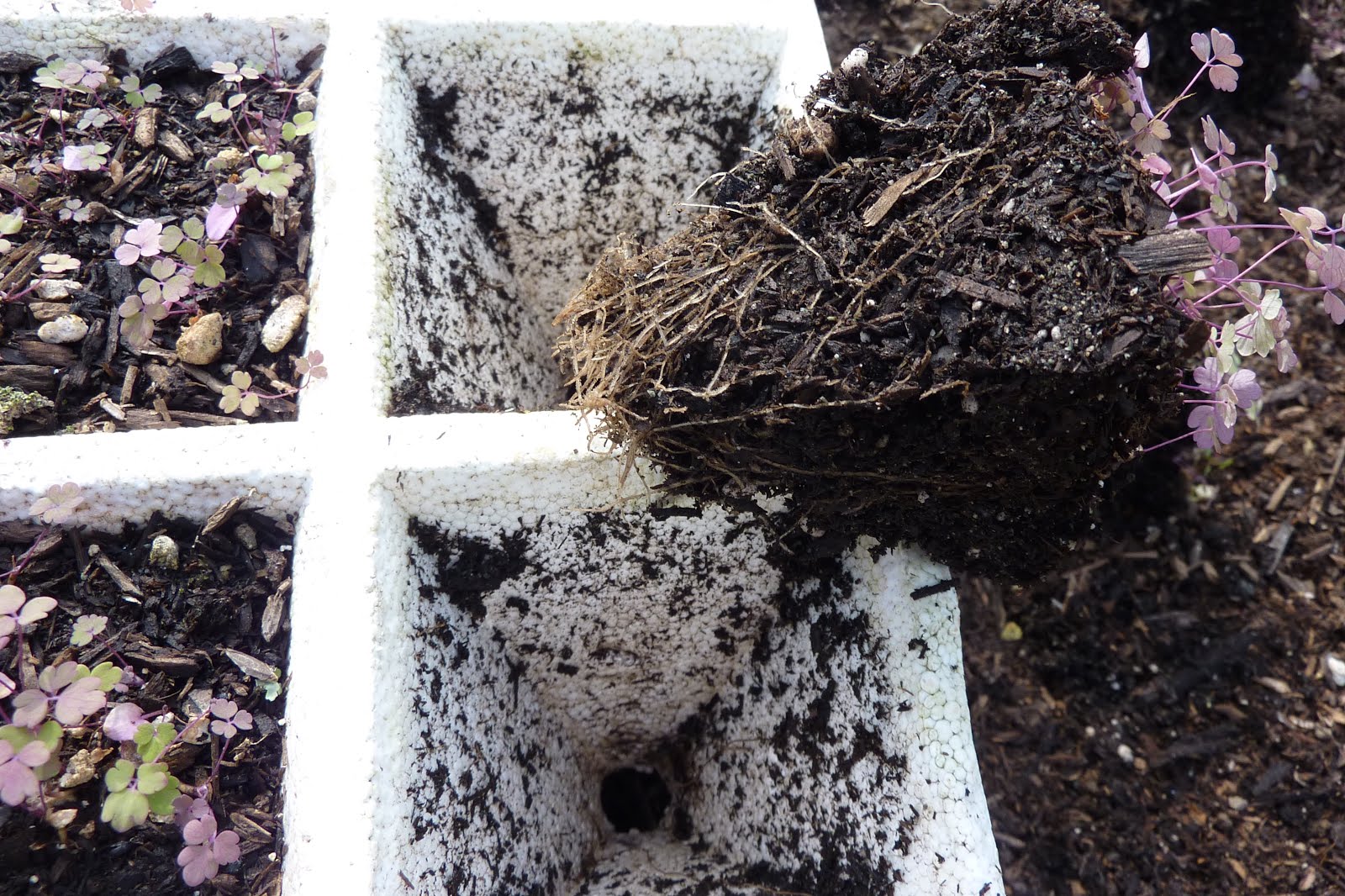
All seeds here at MuRefuge are started in Todd planters.
Each cell has slanted sides and a hole in the bottom.
The starts literally pop out with roots intact, eliminating transplant shock.
These planters are made of styroform . . . ugh! 
The swale near the duck pond, aka old bathtub, has over the years developed
into a small pond. The process has carried away soil so the recent project is
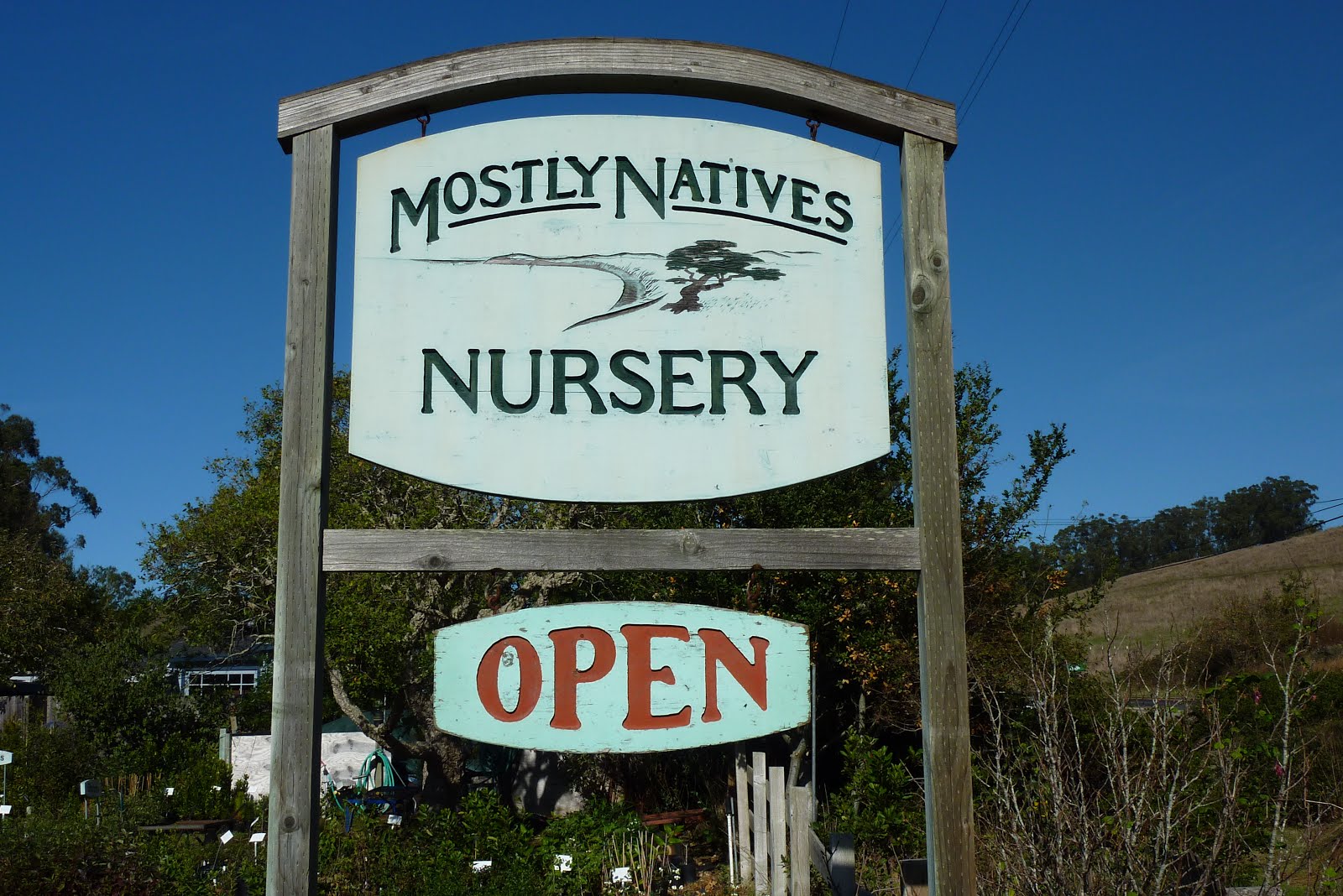
reestablishing a swale of sorts by using tree logs, dead stalks from the perennial sunflowers, dirt, and California fescue (Festuca californica). This particular native bunch grass is frequently used in restoration projects to halt erosion. To complete this project a trip to Mostly Natives Nursery in Tomales happened just a few days ago just after their Spring opening on February 4.

Not only do Walter and Margaret grow natives and other drought tolerant plants
but they have a wonderful selection of vegetable starts
which are certified organic as is everything they grow and sell.

These starts are some of the most vibrant, healthy starts I have seen for purchase.
Merlin and Shasta having a great romp together at Mostly Natives Nursery.
On Friday afternoons some local musicians gather and share their talents.
One of the musicians is Merlin's owner.
Some of you have asked, "where do you buy your seeds?" This year I deviated from the previously used sources, having a glorious adventure. Last year, having read Carol Deppe’s book The Resilient Gardener: Food Production and Self-Reliance in Uncertain Times, I decided to foray into the seed sources she suggested. I bought seeds adapted to the Pacific Northwest, more specifically to the Oregon’s Willamette Valley, from Adaptive Seeds and Wild Garden Seed, as well as from Carol herself. I am excited to find organic seeds produced in a similar climate to the one here at MuRefuge. I have had such grand success buying and growing native plants from Mostly Natives Nursery, which has a climate similar to MuRefuge's climate, that I thought seeds produced in a similar climate would also thrive here. Both Adaptive Seeds and Wild Garden Seed have outstanding catalogs with a plethora of information about seeds like the short article discussing plant genetic engineering "Prepare to Consider the CRISPR." Reading this particular article, I thought YIKES, then to discharge my dismay could only


Sunday, January 31, 2016

Turning


A few mornings ago while sitting looking South
two Anna's hummingbirds appeared to
be dancing to catch the other's attention.
AND then they mated, an events I had not
previous been witnessed. WOW "it knocked my socks off."
The native Manzanita here at MuRefuge
are in full bloom providing nectar for the year
round resident Anna's hummingbirds.

The cyclical turning of the seasons continues with Imboc, or as most of us think of this season, Spring, arriving on Monday, February 1. “The Wheel of the Year is a series of eight holidays, or sabbats, practiced in Celtic and Wiccan spirituality. The sabbats are the solstices and equinoxes plus the four holidays at cross quarters with those solar based dates. There is a sabbat every six to six and a half weeks. They mark the seasons - the journey of the earth around the sun. When you live each day attuned to these rhythms, your life is grounded in the earth and its place in the cosmos.” explains Clea Danaan in her Living Earth Devotional: 365 Green Practices for Sacred ConnectionI find recognizing and honoring this turning fosters my connection not only with the web of life here at MuRefuge but to what the Enneagram calls “higher self” where my “personality” rather falls away and boundaries disappear. 

I love this particular turning of the seasonal cycle, Imboc or Spring. Green is such a vibrant color with so many hues. And here in Northern California with a previous month of El Nino rains, GREEN is the operant word if ones looks about the landscape.  

This view of MuRefuge is looking North from the front of our house. 
In the forefront are native bunch grasses interspersed with Cinquefoil (Potentilla gracilis), 
on the right are Beach Asters (Erigeron glaucus) amidst the low growing 
'Bee's Bliss' (Salvia leucophylla x S. clevelandii); near the oak tree trunk 
in the upper middle are Deergrass (Muhlenbergia rigens) and Brandegee's Sage (Salvia brandegei).


I know many of you reading these words are still experiencing the ground blanketed with snow at best, sleet or mud at worst. Green will arrive soon! 

The days are lengthening so I spend less time sleeping. And here at MuRefuge, the asparagus is beginning to send up its delicious offerings, the fava beans planted last Fall are about 4 to 6 inches tall, 


and weeds are flourishing, giving the landscape here a very green hue, calling my attention to BEing outside and digging in the dirt. Less time sleeping in bed provides me with more time for my very favorite activity of “playing in the mud.” My paternal grandmother fostered this activity by allowing me to make mud pies on her kitchen floor when I was “a little tike.”

My earliest, clearest recollections of garden was at preschool age when our neighbors, Emma and George Oxley of Corwith, Iowa, planted asparagus. In Northern Iowa planting asparagus was a rather labor intensive event. We dug a huge hole/bed in the ground layering this with manure, straw and rich Iowa dirt. This elderly couple not only allowed me to participate but praised highly my efforts. What a satisflying gardening experience for a youngster. As I take care of our asparagus beds here at MuRefuge, I am forever grateful to Emma and George for supporting within me a sturdy foundation for growing our food.

Asparagus shoots growing in our veggie garden, in
a raised bed, of course, to protect the roots from gophers.

As we honor Imboc, aka Spring, may we each 

Wednesday, January 13, 2016

Sandhill Cranes and More . . . Much, Much, Much More


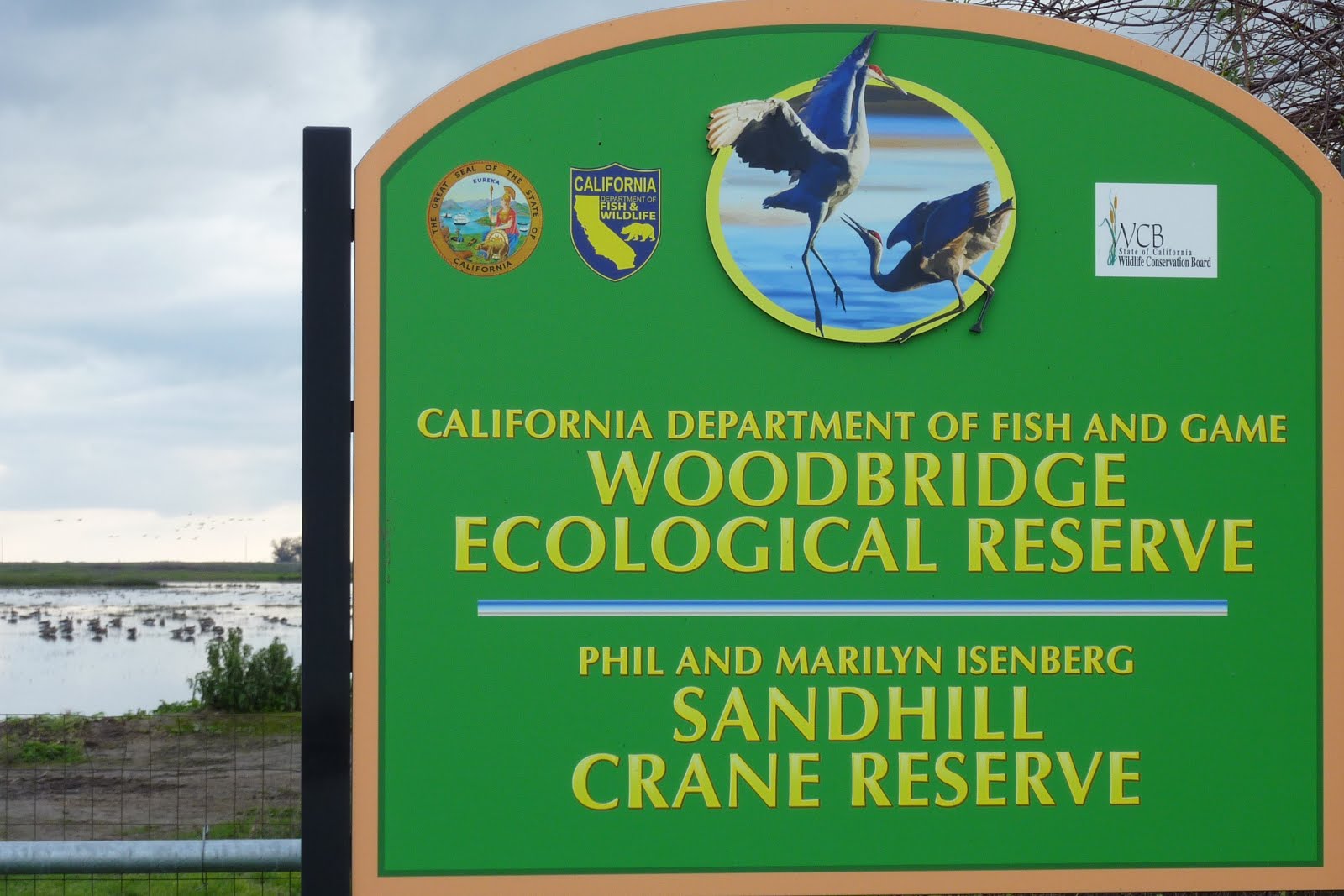
Earlier this week Dwight, Tanis, Shasta and I drove to Lodi: over and on levies, across bridges that rise to allow ships to navigate the Sacramento River from the Oakland Port to the Sacramento Port, along wetlands, some just recently restored and near Grizzly Island Wildlife Area where a reestablishing elk herd resides. Once settled into the Lodi Motel 6 after a brief rest, we joined 27 others for a free 90+ minute tour offered by the California Department of Fish and Wildlife at the Woodbridge Ecological Reserve


We all were there to hear about and see the Sandhill Cranes, both Lesser and Greater. Check out this Aldo Leopold link to see the multiple migration paths of various flocks of cranes. Of course, the bulk of the cranes overwinter on the Platte River in Nebraska and the population wintering in the Albuquerque Area is extremely small, on the verge of "threatened." 


We were not disappointed. These four flew in as the docent was giving her talk. Can you discern the two on the left?  I know it looks like there is only one, but there are two. Look closely and you will notice the number of legs.


Also during the talk this very large flock of Greater White-fronted Geese flew in and settled on the water as well.

The talk ended in time for movement of the group to an area where often at sunset the cranes fly in for the night. Again we were not disappointed. The show, better than anything on TV!!!, included thousands of these magnificent birds flying in from all directions in small groups, often as few as two, four, or six, and large groups with many hundreds. 

Having just viewed a stealth bomber flying over at the beginning of the Rose Parade,
I am reminded of the Sandhill Cranes as they come into land.
Perhaps these awesome birds were the inspiration for this sleek modern day invention?
The landings were amazing to watch with the members of each group settling in amongst those already sitting in the several inches of water, often not with those cranes they flew in with. The sounds were almost deafening and sounds one will remember once you have heard their distinctive voices. “A loud, resonant, wooden rattle hkkkkk or hkarrrr, variable;
a rolling bugle, typically a long, slightly descending roll, but with some variation,” according to The Sibley Guide to Birds.

On the short drive from where we gathered for the talk, we drove our individual cars allowing participants to stop along the way to view the fields covered with swans and geese; intermingled were a few cranes as well. 

Mostly Tundra Swans although upon close inspection other kinds can be identified as well.
This particular preserve is under the auspices of the California Department of Fish and Wildlife and has never been farmed; rather it has been owned previously by “duck clubs.” The entire area has many levies with fields for growing corn, nonnatives grasses, wine grapes and mostly almond trees. The corn and grass fields provide food and resting areas for the cranes, geese, and swans. The vineyards and tree orchards do not, which is the reason organizations sensitive to not only the survival but thriving of other BEings are forming “trusts” to preserve these feeding grounds. In the early Fall along with the adults the 3 month old crane juveniles arrive to feed and grow into young adults before returning to their Northern nesting areas.

The following day, once Shasta had her walk albeit not as long as she would have liked, we had breakfast, packed up and checked out and drove to the Cosumnes River Preserve. Unfortunately Shasta had to stay in the car since “no pets” are allowed on any of the nature trails. There is a sweet, small visitors center filled with information about the flora and fauna of the area. Along the top of the deck railing is a wonderful depiction of the seasonal changes of both the flora and fauna with such information as when the Swainson’s Hawk leaves for its migration to Argentina.

The short Boardwalk Trail and Tanis’s spotting scope allowed all of us fabulous views of the birds gamboling about in the wetlands, both in the water and on spits of land.

Great Egret surveying the wetlands' landscape for food.
What a stunning pair of Northern Pintail ducks.
The male in his tuxedo like attire looks sleek and ever so handsome.
The female is quite lovely in her soft, brown silk like gown.
Lunchtime arrived so we traveled just a few miles to Locke, the Chinese settlement, and now part of the State Park system, finding a picnic table on which to enjoy our lunch we brought. A local stopped by to add a bit of information about the settlement, both historical and present day. The locals are against tunneling the water from the Delta down to thirsty Los Angeles . . . duh!

Notice the picnic table on the other side of the wooden white fence?
That is were we enjoyed our lunch in the warm sunshine.
All three of us noticed the clothes hung out to dry,
demonstrating that, yes, someone still lives in this village.
Then we drove in a circle since all three of us missed the sign for the appropriate turn for our return to Sonoma County. As we recognized several draw bridges and finally arrived in Rio Vista, we all had a good


Saturday, December 19, 2015

Shasta Recommends

Here's me, Shasta,  playing hide 'n seek
with my best friend Coco.
Shasta recommends "enjoying this Holiday Season to the fullest." This happy girl, in spite of her chronic bladder infection, romps and plays as well as performs her job (alerting us of any changes in her territory) here at MuRefuge most effectively. She is also very protective of all the BEings who inhabit MuRefuge. Happiness and enjoyment of life, celebrating each and every moment, are her most precious gifts she brings to both Dwight and me, and everyone she encounters.

Our Great Room decorated for the holidays
and me standing on my organic bed.
Recently we sought a different veterinarian to oversee Shasta's health and well BEing. Dwight, Shasta and I were blown away by this new to all of us experience. Along with Blair, the stellar technician, Dr. Janet Foley, in her Sonoma County Mobile Vet Hospital, arrived promptly for Shasta's scheduled appointment. The well designed mobile vet hospital contained everything needed to provide a full service annual examination.  Curious Shasta watched everything happening in the small organized space. Both Dr. Janet and Blair encouraged our complete participation in the entire process. Both listened to all of us and answered a multitude of questions we had.

A picture of me exploring my gift given to me by
my Auntie T during the first Holiday Season I was at MuRefuge.
Shasta recommends "calling 707-874-1188 if you have a beloved pet who would like a vet to come to her or him with no muss or fuss that traveling in a car to a vet entails."


"like me in the below picture," says Shasta, "this Holiday Season, and throughout the whole next year and beyond."


Friday, December 11, 2015

Wildness this Winter Solstice


May each of us at this darkest time of year,
Winter Solstice, 
go within and revel in our wild nature.
For some belief systems Winter Solstice
is the New Year, an excellent time for new beginnings: 
experience wildness.

Last year at this time Dwight, Shasta and I were on our epic roadtrip with Stella safely carrying us through the natives' land in the Southwest. This wildness experience opened our hearts and minds to another realm. Recently we watched a PBS Special: River of No Return where a couple shared their almost a year in wildness. 

When we saw Ron Mattson's stunning condor picture taken at Horseshoe Bend just outside Page, Arizona (we were there just a few months later) in Birdwatching, we knew we wanted 
to share not only the picture but the message.


We use this California Condor picture
with the permission of the photographer,
Ron Mattson, winner of "online photo of the
week contest" for Birdwatching magazine.
He took the picture midOctober, 2014,
at Horseshoe Bend, Arizona, where
we visited in December, 2014.
One of the reasons his picture was chosen"
"the individual is an unbanded juvenile.
This is significant. It indicates a chick that
was hatched and fledged successfully
in the wild - a critical step in the recovery
of this critically endangered species."


as you create in your own backyard a bit of wildness.


Wednesday, December 9, 2015

Birds Wild and Domesticated


My very favorite little brown bird (LBB)
that visits MuRefuge in the Fall and Winter.
Here is a Fox Sparrow taking a bath one morning past while I was sitting.

WILD

The Fall window washing has been done. Once that was done we continued our goal of decreasing the bird injuries/deaths caused by birds crashing into our expansive amount of windows in our house here at MuRefuge. The windows, especially those on the South side of the house that  infuses both warmth and glorious Winter light, was one of the attractions to purchase this two year old spec. house built in 1991-2.

To this goal we used ABC Bird Tape, tested and approved by bird experts at American Bird Conservancy, on all of our windows except those where we keep our wooden blinds down and where we have installed screens recommended in BirdWatching.  Since birds hit windows because they cannot see glass but rather the surroundings reflected in the glass, the BIrdTape alerts birds to the glass by breaking up the reflection of sky and trees. The tape comes in several options: a 3/4 inch roll or 3 inch roll and precut 3 by 3 inch roll. How to apply any of the choices is clearly demonstrated on the How To Guide.

Here is a sample of how we are minimizing bird collisions.
This is our patio sliding doors with the screens;
the narrow windows above and to the right
with 3 inch precut bird tape.
Recently we had a freak bird accident at one of our bird feeders. After securing the House Finch in a small cardboard box with wood chips on the bottom, and calling and speaking with Veronica at Native Songbird Care & Conservation, the wee one was transported for care. Unfortunately the nerve damage to both legs was too extensive for long term survival in the wild, so Veronica euthanized him.

It was a pleasure to have an opportunity of introduction to this organization.  Visiting the native gardens at the Elphick Road home of this conservation organization is highly recommended. There is an annual Open House in November which is a fund raiser for this nonprofit.

DOMESTICATED

As some of you are aware, The Teacher, one of our two older female Fawn and White Indian Runner ducks, died from a malignant tumor between her right wing and torso (chest). She was such a teacher for all the BEings here at MuRefuge. She took the two Tootsie Rolls “under her wing” so to speak, ushering them seamlessly into our small flock of Indian Runners. The day before she passed she wanted to be carried (she was no longer very mobile on her own) into the veggie garden, one of her favorite spots. The rest of the flock joined her when they were not foraging. The connection and compassion shown by The Teacher and her flock was awesome.

Several weeks after The Teacher’s passing, the three older ducks became abusive towards the two Tootsie Rolls. They pecked at them and chased them away from where they were foraging. Of course, the behavior was upsetting to me and to the cohesiveness of our duck flock. Usually when young ducks are introduced into the flock here at MuRefuge I have used flower essence to ease the introduction and congenial “flocking” together. With The Teacher’s “top duck” influence that had been unnecessary this time. 

The Teacher is in the top left of this picture
and Tootsie Rolls in the lower bottom.
This is of the congenial flock atop our
septice mound covered with perennial
California poppies and native white yarrow blooming.
When the flock division did happen, we used flower essence to support flock integration. What an in depth learning for me on the use of flower essence: clarity on the subtle energy “actions.” It seems to me that all sentient BEings tend to go about in the world operating on “habit of physical form” carried from the previous incarnation. Each BEing seems to have the choice of whether to break/disrupt this habitual way of approaching daily life. Beside the physical body each BEing has a spark or spirit from the Divine (God, Buddha or whatever one chooses to call the Great Spirit). By accessing the “higher self” or that “spark,” a BEing can complete the cycles of reincarnation in that particular physical form. Then when that spirit enters its next physical form, it moves up the evolutionary chain of physical matter.

So flower essence affords the opportunity to connect with one’s higher self allowing a BEing a choice of whether to just go with “habit” (we might call this “instinct” or in Enneagram terminology “personality”) on the physical plane. This process of transcendence demonstrated by our duck flock with support of the flower essence was nothing short of stunning to observe. It seems to me that flower essence allows a sentient BEing to participate in life not only with one’s physical form and learned personality/instincts but with one’s higher state as well. This allows not only evolution of the physical form’s personality/instinct but of the spirit as well. Flower essence frees stuck behavior, and supports participation and “free access” of any BEing’s higher state.

And may we