Pages

Showing posts with label Mostly Natives Nursery. Show all posts

Wednesday, February 10, 2016

Mostly Natives Nursery and Other Awesome Sources

A gloriously cheerful Western Columbine flower in bloom to the delight of hummingbirds.
The feel of Spring pervades all of MuRefuge. The rains have stopped and the temperatures are rising well above average which is unsettling for all the BEings
here at MuRefuge. Undaunted I go forward with planting out the native grasses and perennial flowers started in late Fall of last year. The Western Columbines (Aquilegia formosa) have a home in the bed that previously belonged to St. John’s Wort which I grow for herbal medicine making. Since the sun does not shine on this bed all day, as it did before all the bushes and trees have grown, the plants were dug up and moved to a sunny spot. This is a great location for Western Columbines with some shade and some Summer water since this bed abuts the vegetable garden. They now surround the rhubarb plants, thus reaping protection against red spider. Did you know that rhubarb is one of “our oldest garden plants, which Marco Polo found growing in China centuries ago,” says Louise Riotte in her book Carrots Love Tomatoes: Secrets of Companion Planting for Successful Gardening?
The focus here at MuRefuge is a balanced, ecological "garden." Through experience of planting plants together (aka companion planting) this focus is fostered. Also, fostering balance and well BEing of plants, transplant shock was addressed early on, not only in MuRefuge's evolution but in mine as well. Originally I purchased a variety of cell sizes of Todd planters from Harmony Farm Supply. When this local purveyor no longer carried them, I found Peaceful Valley Farm Supply in Grass Valley carried them. By this time I had honed my seed growing and preferred the 4x8 cell size which I now use exclusively. The original Todd planters purchased are still in use, since with careful handling and care they remain useful.
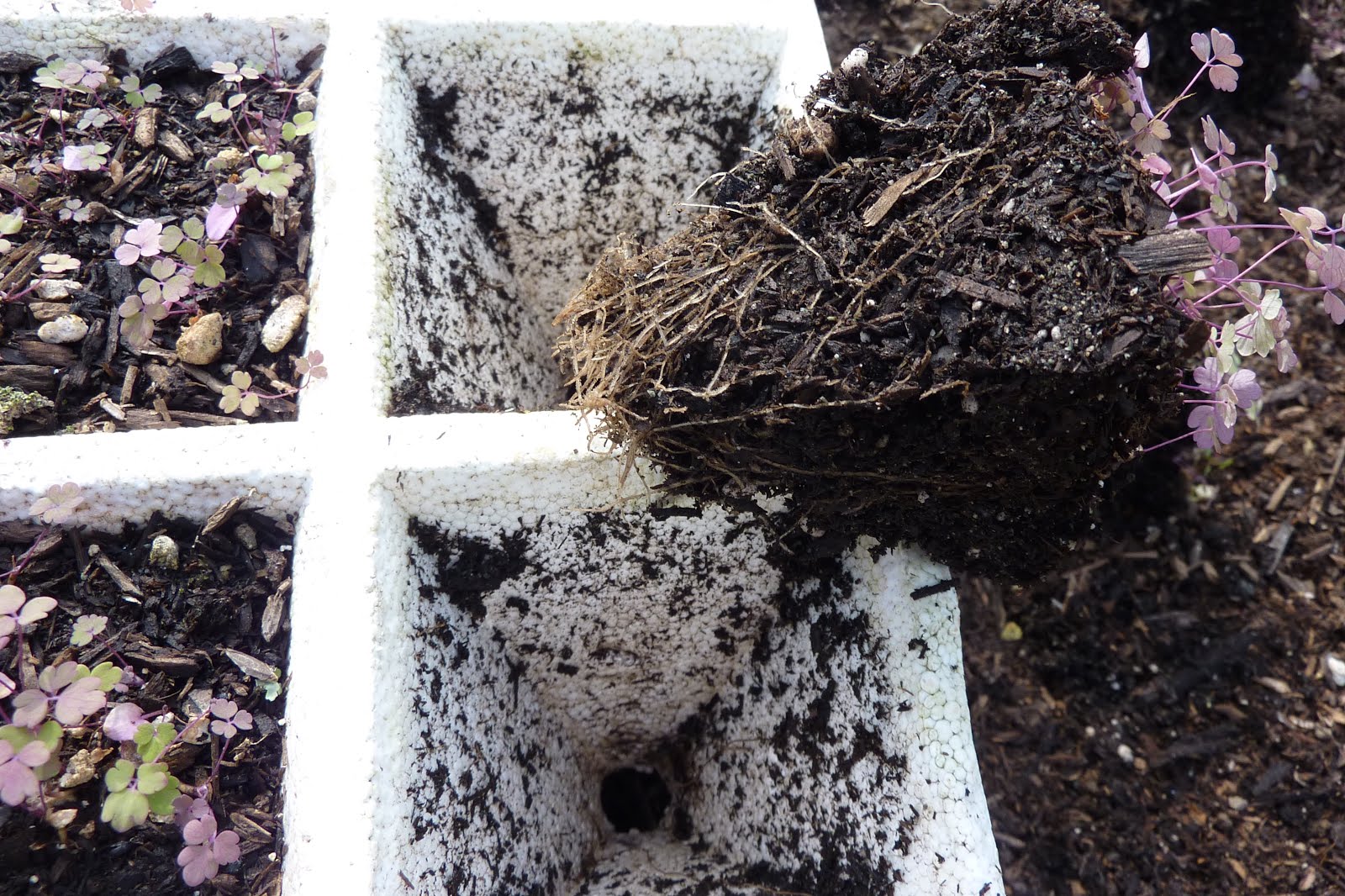
All seeds here at MuRefuge are started in Todd planters.
Each cell has slanted sides and a hole in the bottom.
The starts literally pop out with roots intact, eliminating transplant shock.
These planters are made of styroform . . . ugh! 
The swale near the duck pond, aka old bathtub, has over the years developed
into a small pond. The process has carried away soil so the recent project is
reestablishing a swale of sorts by using tree logs, dead stalks from the perennial sunflowers, dirt, and California fescue (Festuca californica). This particular native bunch grass is frequently used in restoration projects to halt erosion. To complete this project a trip to Mostly Natives Nursery in Tomales happened just a few days ago just after their Spring opening on February 4.
Not only do Walter and Margaret grow natives and other drought tolerant plants
but they have a wonderful selection of vegetable starts
which are certified organic as is everything they grow and sell.

These starts are some of the most vibrant, healthy starts I have seen for purchase.
Merlin and Shasta having a great romp together at Mostly Natives Nursery.
On Friday afternoons some local musicians gather and share their talents.
One of the musicians is Merlin's owner.
Some of you have asked, "where do you buy your seeds?" This year I deviated from the previously used sources, having a glorious adventure. Last year, having read Carol Deppe’s book The Resilient Gardener: Food Production and Self-Reliance in Uncertain Times, I decided to foray into the seed sources she suggested. I bought seeds adapted to the Pacific Northwest, more specifically to the Oregon’s Willamette Valley, from Adaptive Seeds and Wild Garden Seed, as well as from Carol herself. I am excited to find organic seeds produced in a similar climate to the one here at MuRefuge. I have had such grand success buying and growing native plants from Mostly Natives Nursery, which has a climate similar to MuRefuge's climate, that I thought seeds produced in a similar climate would also thrive here. Both Adaptive Seeds and Wild Garden Seed have outstanding catalogs with a plethora of information about seeds like the short article discussing plant genetic engineering "Prepare to Consider the CRISPR." Reading this particular article, I thought YIKES, then to discharge my dismay could only


Friday, March 1, 2013

Spring Happenings

Douglas Meadowfoam at sunrise


SIGHTINGS
On a very cheery Spring note, I heard the remaining male California quail singing while I was planting outside. He seemed very close, and when I looked about, there he was atop the growing brush pile on our driveway that soon will be reduced to chips. He moved all around singing, “where are the females?” We used to have quite a large flock of quail until the proliferation of domesticated and feral cats in the area decimated them.

What a wonderful surprise on the morning of Shasta's birthday.  When I went out to our vegetable garden, I saw not one but two quail: hopefully a pair.

A rare sighting of a Tiger Salamander here at MuRefuge. The endangered salamander was amidst my recycled pots stored in a wooden apple box. What a treasured sighting! Since I was getting rid of the apple boxes, I moved the salamander to the edge of the pond and he, well it could very well have been a she, slipped into the pond. We have a plethora of gopher tunnels so (s)he will have plenty of choices for a home.

IMPERMANENCE
For those that are interested in our small duck flock, two of our fawn and white Indian Runners died. The oldest one who would have been nine next month had a stroke some five and a half weeks ago. The other female , soon to be six years old, has had respiratory difficulties off and on for over a year. She no doubt had Aspergillus, a mold prevalent most everywhere and easily inhaled during foraging. What an incredibly awesome gift to participate in the process of departure of these two ducks from their physical forms!

The remaining six Indian Runners are rearranging their pecking order after a few days of grieving. And now that the days are getting longer the chocolate and two blue Indian Runners are giving us fabulously delicious eggs again.


FARM MARKET AND GARDEN RECIPES
While shopping for bird seed to feed the wild birds who visit MuRefuge, wood shavings for the floor of the Indian Runners’ duck house, organic no soy laying pellets to feed the Indian Runners, and balls for Shasta, the 2012 Annual Natural Dog: your complete guide to holistic dog care magazine fell off the counter into my hands. Both Dwight and I have enjoyed reading it.

One of the features was "Farmers Market Recipe for Dogs" which included recipes for both humans and dogs, one for each season. This prompted the idea to include one of each, for humans and for dogs, here. Since Shasta loves Salmon Creek Ranch pasture fed ground beef, both the human and Shasta recipes revolve around that basic ingredient. The human recipe is “comfort food” for me:

  • 1 package (about a pound give or take a few ounces) of Salmon Creek Ranch ground beef
  • 1 quart of oven, slow roasted fresh tomatoes from our garden, then frozen for Winter use
  • 1 pint of lightly sauteed multicolored peppers from The Patch, also frozen for Winter use
  • 2 to 3 pounds of German Butterball potatoes from Iron Horse or First Family Farm at the local Farm Market

Brown the ground beef in a large cast iron skillet adding chives, also gathered 
from our garden during the warm season and finely chopped and frozen for
Winter use, a bit of sea salt and freshly ground pepper. Place in the bottom of
a 2 to 3 quart Corning Ware casserole dish. Layer the sliced peppers and cover 
with the roasted tomatoes. Top with a thick layer of mashed potatoes whipped 
with salted butter only. Bake for 45 minutes or until the mashed potatoes are
lightly browned and the tomato juice is bubbling up around the edges in 
450 degree preheated oven. Best served in pasta bowls.

And now for Shasta’s recipe:
  • 5 packages of Salmon Creek Ranch ground beef unthawed, lightly sauteed
  • 1 qt. jar frozen grated carrots from MuRefuge’s vegetable garden
  • 1 qt. jar frozen grated zucchini also from MuRefuge’s vegetable garden
  • 1 lg. freshly dug celeriac from MuRefuge’s vegetable garden, grated


Cook last 3 ingredients in 1 qt. water for about 20 minutes then puree and mix with
ground beef.  Fill pint jars and freeze. Defrost and bring to room temperature for serving.

Shasta likes the contents of one pint divided into two meals and add: 
  • 1/4 tsp. each dried kelp, 
  • dried wheat grass (both powdered)
  • and NutriBiotic Buffered Sodium Ascorbate 
  • + 1 tsp. each Freeda Pure Calcium Gluconate Powder 
  • and Nordic Naturals Omega-3 PET

If anyone would like to share recipes, please feel free to do so in the comment section below.

HAPPY BIRTHDAY
Shasta has now arrived at the one year marker and been with us 6 months.  

Shasta deciding which birthday present to open first
The monkey won!
We all (including Shasta’s Auntie T) celebrated with a romp on Dillon Beach followed by lunch at the Deli in Tomalas; certainly a visit to Mostly Natives Nursery, too.

And Kathy, along with Bill and Joan, did you see your 55 species in celebration of your 55th birthday? Here’s hoping you all did so and also had a good