Pages

Saturday, November 7, 2015

Choices at MuRefuge for Supporting Her Restoration


A foggy Fall morning with small droplets of water hanging
on this gloriously beautiful spider web shows off
the work of this very large spider that lives here at MuRefuge.
‘Yankee Point’ (Ceanothus griseus horizontalis) is the
vibrantly healthy shrub on which the web is woven.

As the plants, animals and land here at MuRefuge slowly and methodically reveal their long held knowing, my practices of restoration are likewise evolving. By altering my own attitudes, beliefs and behavior, thus allowing me more internal flexibility, the land's ecological wishes are honored. The process therefore has recently included removal of two-thirds of the lavender bushes and all of the rosemary bushes from our septic mound. Mostly the honey bees, native to Southeast Asia, enjoyed the nectar from these plants; neither the nonnative bees nor plants supported the life cycle of any native BEing here at MuRefuge or for that matter the surrounding territories.
Native Pollinators rather than Honeybees

When faced with what to plant on our septic mound when we first moved to MuRefuge, I chose rosemary with blue flowers for the Southwest end and pink flowering rosemary for the Northeast end.The honeybees loved the flowers. As I learned that honeybees are actually very lazy pollinators compared to the native bees, I began to rethink the massive plantings. 
I have heard from many reputable sources that native pollinators are far superior in doing their job of pollination than the Southeast Asian honeybees. So several years ago the pink flowering rosemary bushes were removed and recently the blue flowering ones as well.

As the lavender bushes, also planted on the septic mound, flourished, I was looked for a way to share the abundance of the  lavender flowers. I contacted the owner of Sceamin' Mimi's, Maraline Olsen, to see if she would like to make lavender ice cream. She said "yes" and also wanted to know if I had any recipes since she had not ever made lavender ice cream. As many of you know their lavender ice cream is now highly sought after, and has won almost as many awards as Mimi's Mud. Since they do not use an organic "mix" for their ice creams and my body is pretty picky when it comes to what I put into it, lavender from MuRefuge is no longer making its way to this local ice cream shop. So about two thirds of the lavender bushes have also been removed from the septic mound, leaving enough for use here at MuRefuge: in salve for its healing properties, in closets and drawers to deter pesky insects, and to hang in the Great Room for its beauty and fragrance.

Another example of the knowledge gleaned from Permaculture:
chipping all of the rosemary and lavender bushes
provides an abundance of carbon for redistribution on the soil here at MuRefuge.

Three Sisters

With the success of the Three Sisters (bean, corn, squash) planting experiment this year, more space is needed is needed to expand upon the learning. Where the rosemary has grown for 20 years fava beans will be planted atop the septic mound as a cover crop and for mulching. In several small areas about the septic mound native plants communities have been planted. The plants chosen will provide not only nectar for the native pollinators but over time will create beautiful ecological niches for a variety of native BEings who have inhabited this area long before humans.

"We abuse the land because we regard it as
a commodity belonging to us.
When we see land as a community to which
we belong,
we may begin to use it with love and respect."
A Sand County Almanac (1949)
Aldo Leopold

Confetti Bed

  
What has been called the Confetti Bed has likewise been replanted with native perennials and shrubs, a hedgerow of sorts. The borage, calendula, edible chrysanthemums, pineapple sage are grown for their edible flowers and are depicted below in a picture of the present miniaturized variation (minus the calendula) that is now by the veggie garden gate. The edible chrysanthemums are an annual. When seeds are scattered each Spring, the flowers not only have solid yellow petals, as pictured below, but white with yellow tips petals. None of these plants are native. They were chosen for their culinary use. The native pollinators seem to enjoy their nectar as well.


The blue, red, yellow plus the orange of the calendula makes a beautiful edible confetti for fruit or veggie salads, or for sprinkling onto a frosted cake or for scattering atop Summer sorbet or ice cream. The favor is subtle and the fragrance divine.

The hedgerow, of sorts, is comprised of, from West to East:
  • Oregon grape (Berberis aquifolium)
  • Hummingbird Sage (Salvia spathacea)
  • Snowdrop Bush ((Styrax redivius)
  • California Fuchsia (Epilobium c. Chaparral Silver)
  • California Wild Lilac Maritime Ceanothus (Ceanothus m. Valley Violet) x 2
  • Evergreen Currant (Ribes viburnifolium) x2
  • Coast Silktassel (Garrya elliptica 'Evie') 
  • California Wild Rose (Rosa californica)
  • California Fuchsia (Epilobium c. Schieffelin's Choice)
  • Fireweed (Epilobium angustifolium)

This 'Carman's Gray' in full bloom located in MuRefuge's front coastal prairie
provides nectar for the year round Anna's  Hummingbird.


Medicinal Bed

Early on in MuRefuge's creation when I was focused on healing, a medicinal herb bed was created. Agrimony, Feverfew, Marshmallow, several varieties including a native Mugwort, Tansy, Valerian, and Vervain were all planted and flourished, especially the Mugwort which invaded beyond the borders of this bed to become a "ground cover" when mowed.


The burr like seed pods of the Agrimony easily imbedded in the fabulously silky, soft, long fur 
of Rose's ears. Even though she was extremely patient as these were teased out of the fur, the Agrimony plants were all removed from the Medicinal Bed.

Over the years most of the medicinal herbs have disappeared for one reason or another with the exception of Tansy which is hung in closets or laid in drawers to deter predatory insects, and the small button like yellow flowers makes a lovely addition to dried arrangements. Recently all of the Mugwort was removed, the area sheet mulched with chips from the pile on MuRefuge's driveway depicted above. Through the sheet mulching a new plant community was planted:

               Along the East veggie garden fence:
  • Coastal or Narrow leaf Milkweed (Aesclepias fascicularis)
  • Showy Milkweed (Aesclepias speciosa)


After reading recently Susan Wittig Albert's blog post on Lifescapes about nonnative milkweed and the lethal effects on Monarch butterflies, a choice was made to increase the native milkweed growing here at MuRefuge. 'Davis' Showy Milkweed pictured above is not only beautiful when in bloom but extremely fragrant as well.

Then another choice was made to add another plant community between the newly planted milkweed and the well established White Sage (Salvia apiana):
  • Douglas Iris (Iris douglasiana) 
  • Nodding Needlegrass (Nassella cernua)
  • Coyote Mint (Monardella villosa c. Russian River)
And when the Beach Asters (Erigeron glaucus) and California Asters (Aster chilense c. Point Saint George) that are sprouting from MuRefuge's own seeds in the greenhouse have grown enough to thrive outside, they will be added to this community.

Ceanothus and Coast Silktassel Bushes

In the front along the West fence late this Summer I did a long overdue clean up. Oh my gosh, now I remember the plan some ten or probably more years ago of planting Coast Silktassel (Garrya elliptica) bushes some 8 feet apart and in between a variety of ceanothus (also know as California Wild Lilac). My thinking at the time was that as the ceanothus died (they are a relatively short lived shrub), the Silktassel bushes would grow into and fill the space created by the spent Ceanothus. During the long overdue clean up that is exactly what was found. "BEing Rooted and making choices honoring the plants create over time a thriving habitat," I thought to myself.

Gophers

Over the time BEing Rooted has evolved, many of you have asked how to get rid of  gophers. When beginning to put roots in here at MuRefuge, we (both 2 and 4 leggeds) went about killing off the gophers. The picture below is of 10 month old Sun and her 2 1/2 years old sister Star.
 When we moved to MuRefuge, led by Star they took it upon themselves 
to be the gopher patrol. Sun perched on one end of a
 gopher tunnel and Star on the other. They would dig
 towards each other until a gopher was caught. Star would play with it until
 the gopher was dead then Sun would gobble up the organic meat.
 Star was not into eating gophers! In this manner they trapped over their first year here
 some 50 gophers. Dwight trapped with cinch traps
 almost as many.


The above picture was taken soon after we began inhabiting MuRefuge. The decorative white picket fence has been removed but the fence white posts remained until my stepfather, Steve, came in the Fall and painted all of them. And in the background you will notice trees. These very old apple trees were gorgeous in their Sping flowering. Unfortunately only a few years after we began BEing Rooted here, the trees were all removed.


Of course, as you can see in this picture of Sun sitting in one of their digging for gopher events, the catching of gophers surely changed the landscape.

As these two 4 leggeds passed and a different breed of dog came to BE at MuRefuge, our relationship with gophers changed. I remember talking with a woman who brought organic fresh cut asparagus and organic, perfectly ripe peaches to the Original Farmers Market in Santa Rosa ("Do not squeeze the peaches," she would say to everyone visiting her booth and picking up a peach). I asked her about how she dealt with gophers. She said there was enough for everyone, gophers included. At the time I thought that a bizarre way of looking at gophers AND now I completely embrace her point of view. I plant clover and nasturtiums aplenty for their eating enjoyment. MuRefuge does provide enough for all BEings who inhabit or visit her.


Now we have Jax who sits patiently by an obvious gopher hole waiting for one to pop out; then he catches the unsuspecting BEing. I have watched him delicately consume the entire rodent in short order. He leaves the head and, like Sun did, the teeth of his freshly caught and eaten gopher.

Of course, native perennials and shrubs are planted in gopher baskets to give each plant an opportunity to establish itself. The native bunch grasses are planted directly into the ground. This practice has evolved and now has been done for a number of years. I find the gophers nibble on the roots but since they are so massive they do not kill the native grasses.

As we consider making conscious choices, rather than those driven by habit, may we each


Monday, October 26, 2015

Compassion Informing Observation: the Butterfly Project

Many of you locals have probably visited or at least heard of the local butterfly guru, Louise Hallberg. She has a history of bringing caterpillars into her bathroom to protect them from the elements. So when Rob recently told me of the latest evolution of his "butterfly project," I thought to myself, perhaps others would be interested in hearing of his efforts. So here is what he has written for your amazement and enjoyment, too.The pictures are taken and provided here by Rob, as well as the text, of course.

THE BUTTERFLY PROJECT

With Cathie’s prodding, I am presenting my Swallowtail Butterfly experiment.  I am an observer of nature and its creatures.  Over the years I have watched the Swallowtails on their host plant of fennel.  The caterpillars seemed to be disappearing around mid-term in their development.  The few that did get quite close to maturity would also disappear.  It had to be the birds, so I decided to assist Mother Nature.

My first experiment was to erect a framed netting of the host plant.  I also moved new hatchlings under the cover.  Their development went well, but close to maturity, all would disappear at once.  I decided the Brown Towhee was the culprit because of their ground dwelling nature; they probably entered from underneath the netting, the most vulnerable area.

Next I brought the caterpillars into my sunroom where I kept a small fennel plant.  This seemed to work for a while for I got three caterpillars to the chrysalis stage. This was a bit more rewarding.  All of a sudden these new caterpillars disappeared.  I eventually observed a sparrow feeding on them. 
My new plan was to move the operation into the house.  My incubator became a bouquet of fennel which I picked fresh each day.


This also became a focal point of interest for everyone in the house.  I usually had two to three bouquets going at once with a total of five or six caterpillars on each clump.  I had to keep the mature ones separate from the tiny hatchlings or else they disappeared; I could only image their fate.

I inserted several 18 inch long plant stakes around the bouquets for the mature caterpillars to crawl up on to form their chrysalis.


Most cooperated but I did have a few escapees, most of which I easily found, but several are still in the house somewhere.

Once the chrysalis had formed on the plant stakes, I moved them to another location, forming now a stake bouquet.  The hatching of the cocoons was very thrilling.  


It took a half hour for the butterfly to fully expand and dry and another half hour before flying.


The butterflies always hatched in the morning and the hour of emergence gave me time to get them outside.  The few that I missed always flew to the light so I found them at the nearest window. They did not want to fly until they were in the sun.

The caterpillars took two weeks to reach maturity and form the chrysalis.  It was usually another eighteen days before they emerged as butterflies.  It was always a wonder to imagine how much butterfly could emerge from such a small cocoon.  This was truly the ultimate wonder.

I now have fourteen chrysalises that have not hatched.  The last one emerged in early August.  Now I have a new quandary; they must winter in the chrysalis stage.  Their host plant is in decline and unproductive so there is no more time for another life cycle.  Only the Monarchs migrate and winter in their adult stage.  Temperature cannot be the trigger for hatching for fall is usually the warmest time of the year.  I am to conclude that the lengthening daylight of spring has to be the activator for the butterfly to emerge.  I should not store the chrysalis in a closet for the winter as they will need exposure to daylight.  Proceeding on this premise, I am extremely excited to see what happens this coming spring.  Will some or all hatch?


Rob Bartlett has co-authored Balanced Destiny and more recently authored The Awakening of a Wizard. He also is excellent at trimming my hair to take advantage of the curliness that has appeared with the graying. Both Rob
and I are "green wood Monkeys" so I love visiting with him every few months as he takes excellent care of trimming my hair.

Thank you, Rob, for sharing your "Butterfly Project"

Sunday, October 25, 2015

Permaculture and Place


September 27, 2015 Full Moon (Super, Blood moon) eclipse resolving

When we bought and moved to MuRefuge in December, 1993, neither Dwight nor I had lived in one place for enough time to identify with "place," much less grown roots. "BE-ing" at MuRefuge was essential for me not only to live but to thrive: I was in the throes of recovering from a disabling autoimmune disease and healing from an infancy trauma. Out of this process came the title for this blog and each ensuing post: "BE-ing Rooted: a Practice in Essential Living."

Aristotle’s Physics"the potency of place must be a marvellous thing, 
and take precedence of all other things.”  
. . . . place is "that without which nothing else can exist”

BEFORE: Summer, 1994
Digging swales, a Permaculture idea for water catchment,
along our South property line designated by the fence.
Keith Johnson, who unfortunately no longer resides in Sonoma County, was the Permaculture resource we used here at MuRefuge. His way of proceeding was to gather individuals interested in the the topic he wanted to demonstrate and have a hands on workshop. Our water catchment system of swales was dug in a weekend workshop with very little money changing hands and loads of dirt moved.

The purpose of swales is to slow the flow of water so it can soak into the ground. By doing so the groundwater table can be elevated. The rapid flowing water would leave our property otherwise. These particular swales were dug more like a flowing river with bends and turns, replacing a concrete straight "ditch" along the fence line which diverted all the water to the property to our East. We call these bends and turns our wiggle waggles with peninsulas on which to plant. The first and second round of plantings did not take, however, the third depicted below did.


AFTER: Fall, 2015 depicting Oregon ash in the background
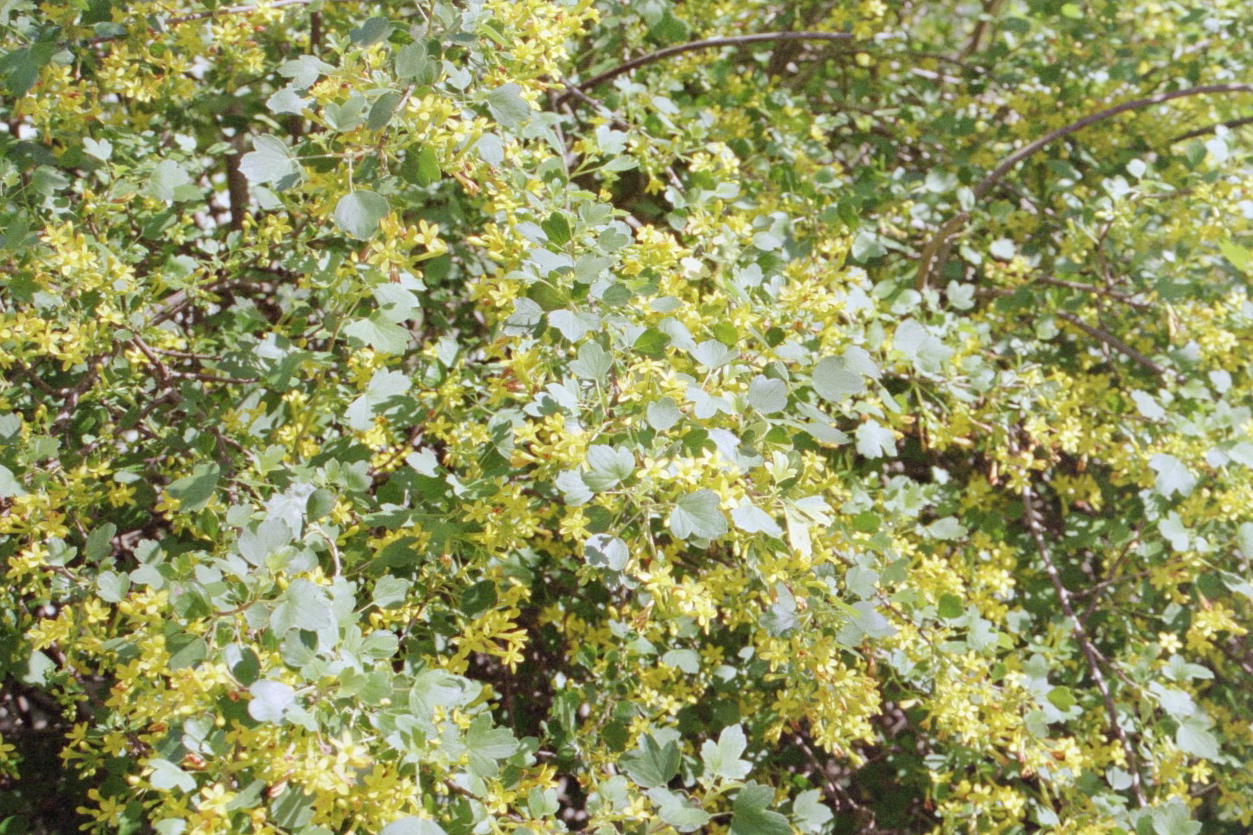
and Golden Currant (Ribes aurum) in front of the trees
and  California Fescue (Festuca californica) just
behind the reused concrete blocks used as stepping stones.
In the before picture I was standing in the far left corner of this after picture.

Golden flowering currant in all its very early Spring splendor.
Permaculture, as originally developed by Bill Mollison, is a way of viewing one's land
or property as becoming self sustaining for all the inhabitants of this particular spot on the planet  The elements (water, soil, air/wind) as well as the topography (the Feng Shui of MuRefuge is very good) are considered when planting, building or using the land in any way. I have found the concepts immensely helpful in many ways: a wind break to protect from the fierce wind whipping through the Wind Gap from the ocean to the inland way East of us, swales to slow the water flow across our property, planting nitrogen fixing plants to feed the soil as well as sheet mulching to also feed the soil by returning the mulched organic matter to the soil as well. Many of you know and have chuckled at my practice of mulching our tattered natural fabric clothes in this sheet mulching. This list is of course not exhaustive but gives you the reader an idea of how Permaculture was applied to MuRefuge.  

The big divergence from Permaculture at Mu Refuge was the plants themselves. Initially, many nonnatives were planted and most of them except the Italian alders have been removed. My committment to native vegetation has burgeoned over the years. Many native plants meet many of the same Permaculture requirements. For example there are native clovers that nitrogen fix just as well as nonnative ones, and native alders nitrogen fix just like their Italian sisters. If I had only know that in 1994 I would have planted native alders along our West fence/property line! Fortunately the Italian Stone Pine trees we also planted there did not like the wetness so they all blew over. These were replaced with Coast Live Oaks (Quercus agrifolia) which are thriving, providing food and shelter for native BEings to this area.


Two Coast Live Oaks growing in the Southwest corner of MuRefuge
We had the most beautiful little BEing visit our Great Room a few days past, when the sliding door's screen was left open for Shasta to come and go, while eating lunch. When I climbed up holding a towel to catch the wee one, I could clearly see the "distinctive white supercilium" of the Red breasted Nuthatch who left behind, when caught and released out of doors, 3 stunning little feathers.

BEing rooted in the place one lives allows one to connect with the cycles of seasons and thus the changes in everything that inhabits the place in which one is rooting. It seems to me the frequent disconnect from the natural cycle we have all felt at some time or other in our lives gives rise to the "human stupidity" that the bumper sticker on one of our neighbor's car states:

"Only two things are infinite:
the universe and human stupidity.
And I am not sure about the former."
Albert Einstein


At our own human stupidity may we each


Tuesday, September 22, 2015

Soil Not Oil: Part II

Lisa Bunin, PhD, of the Center for Food Safety explains, “When you eat organic, 
you can feel confident that you are contributing to a better world by supporting farmers 
and farming practices that steward the fertile land upon which a secure food future depends.” 
The organic policy director explains that the impact of choosing to purchase and eat organic foods
 not only benefits our bodies, but also nourishes soil, conserves water, restores ecologic diversity, 
and protects the health of farm workers and communities. 
As such, Lisa supports the take-home message of 
Maria Rodale’s book Organic Manifesto: 
“If you do just one thing—make one conscious choice—
that can change the world, go organic.”
from The Cultivator, September 15, 2015

NonGMO Top Hat corn pollinated by Anasazi corn.
Pimento peppers from MuRefuge seeds.
Not only stunning, but tasty too,  Anasazi corn.
Relish made with Pimento peppers and Anasazi corn
When one grows the food one eats, one does not need to question what is in the food. Food
grown at MuRefuge is grown in soil that has been regenerating for some 20+ years now. The vegetable beds get compost from our compost bins on a regular basis as well as comfrey tea made right here at MuRefuge. 

When one eats out or buys one's food, what is in the food is often unclear and the source of the food often a mystery. We are so fortunate here in Sonoma County to have not one but two places to eat out where the source of the food is clearly identified. Peter Lowell's in Sebastopol has been open since October, 2007 serving organic food which is sourced from local farms. I simply love their Italian like pizza cooked in their brick oven. The second restaurant has been more recently opened a few years ago and is located in Forestville, a short jaunt North on Highway 116 from MuRefuge. The Backyard is unique in that it sources its food from farms West of Highway 101, totally in The West County (of Northern California's Sonoma County). For brunch they offer duck eggs as an alternative to chicken eggs which my body is unhappy to have ingested. My latest anti-agribusiness stance: we not be consuming feedlot meat nor sludge fed vegetables. 

Shopping for food at the Sebastopol Farmers Market is a delightfully social event for me. Talking to the farmers about their practices is always fun and enlightening. The two vendors I buy most regularly from are Singing Frogs Farm and The Patch that is owned and farmed by a knowledgeable Mexican man. Not only are the vegetables grown at these farms more tasty, the qi is obvious. What vegetables I choose to buy to augment the abundance from right here at MuRefuge is informed by moderation and seasonality. I do not buy kale every week and with good reason if you check out the information now available about kale and her relatives.

From my point of view, Americans have become passive about food, accepting the new and latest fade and/or "the spin" put on what is good for us. Often what passes as food is not real food but rather processed beyond recognition. During a visit to an organic vegetable garden the children were asked to name a vegetable they liked and one child answered, "spaghetti." "Yikes!" I thought when I heard this.

So I was ever so delighted while attending the Soil Not Oil conference in Richmond, to hear from so many of the young adults sharing their "work" to bring attention not only  to
regeneration of the soil but also to the nutrient deficient food produced from our depleted soil (not to mention the lack of life giving qi).  Others shared their concern for the masses consuming processed food created by the megacorporations that support agribusiness in their toxic approach to soil depletion and offered examples of solutions practiced by this energetic, focused 20's and 30's generation. These young people are acting to reverse the time bomb (climate change) created by their forefathers. 

One of the Plenary II speakers was a young woman from Mexico, Adelita San Vicente Tello,  who is protecting Mexican corn against GMO manipulation. She shared that corn is an "invention of ours and corn invented us" since corn has been grown in her native country for over 8000 years. Using Dr. Vandana Shiva's mentorship, in 2009, she organized legal action to halt corporate ownership of corn and asked for respect of our right to what is ours. Of course, the big corporations pushed to stop the legal action. Mexico's opposition to GMO corn is the biggest effort of any country worldwide.

Claire Hope Cummings, an environmental/native land rights lawyer and journalist, encouraged everyone in the audience to consider "an inconvenient truth versus a reassuring lie." She talked of industrial agriculture creating both human and natural catastrophe in the not so distant future. Industrialized agriculture is dehumanizing, while the land is more productive when people "farm" as "family". She shared her view that storytelling that nurtures both humans and the land has great power to shift one away from the "reassuring lies" of industrial agriculture. Her most poignant example was the story of Skywoman appearing in Robin Wall Kimmerer's Braiding Sweetgrass. Regenerative agriculture brings forth a commitment to nature as well as laughter she stressed. Also, she reassured the audience that "science" is on our side. Check out IAASTD for more on this. 


"We abuse the land because we regard it as a commodity
belonging to us. When we see land as a community to
which we belong, we may begin to use it with love 
and respect."
Aldo Leopold, A Sand County Almanac (1949)

Anna Lappe, mother of a three year old and coauthor of report Spinning Food: How Food Industry Front Groups and Covert Communication are Shaping the Story of Food, succinctly shared how the megacorporations are using the growing social media networks with such themes as "trust us, we're the experts," "toxic sludge is good for you" and creating frontline presence with such organizations as US Farmers Ranchers Alliance, Alliance to Feed the Future, Protect the Harvest and Global Harvest Initiative. I would encourage any of you who frequently "google" to get information on the web to check out the entire report on Food MythBusters before accepting the information from whatever wbsite comes up first in your search.

And everyone sharing my table for Plenary III knew Vani Hari, aka Food Babe. Her story of moving from ill health to recovering her vibrancy struck a cord with me. This first generation Indian whose parents moved from India to this country so her father could continue his college studies ate from infancy processed American food as her father mandated. Reaching young adulthood in a very debilitated and robot like state, she set out to discover what exactly was in the food that everyday Americans ate. For example she discovered that the US Kraft's mac 'n cheese had toxic additives, but not so with that product sold and eaten in Britain. Through initiatives started on her blog she has successfully altered what big companies put in their food or what kind of food they buy. Did you hear that McDonald's, who uses one-third of all eggs produced in this country, is going with cage free eggs and Chipotle is going with organic meat? If we the people step out of our trance and speak up, we can make a difference. 


MuRefuge's pantry filled with the abundance from her three quarters of an acre.

As each of us consider "an inconvinient truth versus a reassuring lie" and commit to the regeneration of soil and health giving, nutrient dense food, may each of us 


Saturday, September 12, 2015

2015: Year of Soil, Part I

Round Up sprayed on "weeds"
by one of our neighbors early this past Spring.
For the first time in modern history, an entire year has been dedicated to soil. 2015 is
none too soon in my view. When I see the desecration from Round Up and feel the
loss of life of the soil and all its inhabitants, my whole BEing is filled with grief.


The 68th United Nations General Assembly has declared 2015 the 
International Year of the Soils. And not a minute too soon,
 if you put any stock in Franklin D. Roosevelt’s 1937 warning:
 “The nation that destroys its soil destroys itself.”


For decades, we’ve been poisoning our soils with chemical fertilizers and pesticides.
 We’ve been overgrazing and overfarming our soil to the point that 
what were once prairies and grasslands teeming with life, 
are now lifeless dust fields.

     from Organic Bytes weekly e-newsletter

In the week past I attended one day of a two day conference in Richmond, California: Soil Not Oil (the title originated from Dr. Vandana Shiva's book Soil Not Oil: Environmental Justice in an Age of Climate Change). Those of you living in the Bay Area are well aware that Chevron has a huge refinery that periodically spews toxins into the air threatening the health and well being of Richmond's inhabitants. So, in my humble opinion, it was no accident that Richmond was chosen for this awesomely stellar conference and its mayor gave the welcoming address.

Before my life changing illness, conferences, lectures and such were common places for me to accumulate information. Once the rooting process at MuRefuge began my attention shifted to listening to the ancient knowing of the land and its inhabitants. This conference spoke to me and I am ever grateful to have listened. The basic message of the day was that global capitalism, practicing extraction from our planet to pour dollars into investors pockets and patriarchal dominance, is no longer viable. Regeneration* was the "word of the day" so to speak. 

     *"Regenerate: to give fresh life or vigor to; to reorganize; to recreate the

      the moral nature; to cause to be born again" New Webster's Dictionary, 1997

The myths that capitalism wants us to believe are now repeatedly refuted with hard science and logical approach: the land tilled (raped) by agribusiness grows little food to feed the world. This land is used to raised crops for biofuel or to feed animals, mostly cattle, in feed lots. Growing nontoxic healthy food is a solution to climate change. Not tilling the soil 
and not using manufactured fertilizers nor soil amendments, not using herbicides nor pesticides (oh my gosh how those practices would undermine agribusiness capitalism!) is the foundation for regeneration of the soil. Research has repeatedly been done to demonstrate that tilling the soil is detrimental to its maintaining its vibrant, dynamic population of worms, insects and microscopic organisms that not only absorb carbon but feeds the plants living in undisturbed soil as well. Growing food on the present amount of land presently farmed world wide is enough to feed not only the present population but the one predicted for the future IF regenerative practices replace the capitalist ones so widely now used.

Soil carbon restoration can be accomplished with methodical practices, and with many of us participating we can make a difference in climate change. Each one of us have the choice whether to support in our daily lives the present path to our extinction OR alter our beliefs, attitudes and habits and get on board with regeneration of the soil. 

The action steps printed below have been copied from the Northeast Organic Farming Association/Massachusetts Chapter


How can you take action in your own life to restore carbon to the soil and help rebuild the marvelous system that nature has put in place to renew our atmosphere?
Below are just a few of meaningful action steps for farmers, gardeners and homeowners, landscape managers, consumers and businesses, activists and educators, and policy makers to take. We will be editing and building on this list regularly, so check back often.
Farmers
  • Plant nitrogen fixing cover crops and living row paths.
  • Incorporate no-till or shallow till practices.
  • Recycle biomass with livestock (grazers, browsers, compost to poultry).
  • Replace pesticides and fungicides with diverse beneficial organisms.
  • Incorporate perennials or pasture cropping into your farm plan.
Gardener/Homeowner
  • Plant your lawn with diverse species, including deep rooted grasses and nitrogen fixing species like clover.
White clover growing between all our gopher proof raised vegetable beds
and our Tootsie Rolls (the 2 youngest female
Indian Runners) who by the way are now
producing daily an egg each. 
  • Mow, cut back, and/or heavily mulch over weeds instead of pulling.
  • Incorporate multi-layer, perennial, diverse plantings into your yard.
  • Compost, rather than burn, your yard waste.
  • Plant nitrogen fixing cover crops and living row paths.
Landscape Manager
  • Emphasize perennials in plantings and fill in gaps with annuals.
Spring flower annual natives growing amicably with native
Nodding Needlegrass (Nassella cernua) beneath one of my favorite trees the
Black Locust (Robinia pseudoacacia) which fixes nitrogen and is a native to the
Eastern U.S. but has naturalized in California.

  • Incorporate nitrogen fixing trees and perennials into the landscape.
  • Minimize the use of pavement and unproductive mulch.
  • Maintain diverse forested buffers and perimeters (can be productive).
  • Mow, cut back, and/or heavily mulch over weeds instead of pulling.
Consumer, Investor, Funder or Business
  • Purchase food from farmers that use regenerative and organic practices.
  • Stop buying from/supporting large scale, conventionally grown soy, corn, canola and cotton products which use synthetic nitrogen and persistent herbicides, contributing to massive soil loss every year.
  • Compost your kitchen waste.
  • Consume only 100% grass-fed and pasture raised meats, looking for farmers and ranchers prioritizing soil building.
  • Invest your food dollars in local farmers building soil, invest your climate action donations and advocacy into reforestation and reversing desertification (rehydrating the land) locally and globally.
Activist/Educator
  • Advocate against factory animal operations and for properly managed grass and pasture based farming.
  • Support replanting your local environment, support diverse meadows and deep rooted grass landscapes
  • Get to know diverse plants and biodiverse ecosystems in your region.
  • Invest your climate action donations and advocacy into reforestation and reversing desertification (rehydrating the land) locally and globally.
  • Study soil microbe biodiversity and support composting everywhere.
Policy Maker
  • Rule out synthetic nitrogen fertilizers on athletic fields, institutional and public park lands.
  • Prioritize climate funding for carbon farmers and ecosystem restoration.
  • Align local building codes with biodiversity and habitat regeneration and protection.
  • Emphasize development projects that regenerate, preserve, and do not destroy soil ecosystems.
  • Prioritize green infrastructure for coastal and inland flood management.


Did any of you view 20/20 last week? David Muir was at the Vatican with the Pope who then communicated with people gathered in 3 U.S. cities (Los Angeles; McAllen, Texas; and Chicago). I was brought to tears as the Pope opened his heart to these people telling their stories. Pope Francis is an beatific  amazing BEing; an exemplar for each of us whether Catholic or not.
"Where profits alone count, there can be no thinking about the rhythms of nature, 
its phases of decay and regeneration, or the complexity of ecosystems 
which may be gravely upset by human intervention . . . .
It is not enough to balance, in the medium term, the protection
of nature with financial gain, or the preservation
of the environment with progress.
Halfway measures simply delay the inevitable disaster."
Pope Francis, Papal Encyclical "Laudato Si," June 18, 2015

As we each consider how we each may contribute to this exciting life giving process of restoration, may we