Pages

Showing posts with label Gophers. Show all posts

Saturday, May 21, 2016

Accepting

Living here in the Sonoma “West County” its human inhabitants understand that gophers, in abundance, live here also. Our neighbors to the West had to replace their above ground swimming pool with a cement pad beneath when the gophers nibbled through the bottom of the pool. And when most perennials are planted at MuRefuge they are installed in gopher baskets.

Gopher baskets give young roots a chance to grow and feed the plant of which they are a part. However, they are temporary after years of sitting in damp soil. Even with many years of drought here the soil still does get damp from the intermittent rains. As the gopher baskets disintegrate and are incorporated into the surrounding soil, the apple trees seem to be the most susceptible to the gophers who apparently like the taste of their roots!

Accepting all that appears at one’s place of setting down roots is by no means easy. Accepting can be simple, however. As I surveyed  this Pink Pearl apple tree a few weeks ago, I noted the foliage was droopy and the little green apple were wizened. Since this is not the first apple tree to have lost its root system to the gophers, I wiggled the trunk: not too wiggly. But once the dead vegetation was removed not much soil needed to be removed from around the trunk before the entire trunk and what was left of the roots system could easily be pulled up from the soil. 

Remains of a 30 year old dwarf Pink Pearl apple tree.
As I set the trunk in the pile to be chipped, I was grateful for all the Pink Pearl apples this dwarf antique apple tree has given us over her many years. 

Pink Pearl apples picked and ready for applesauce making.

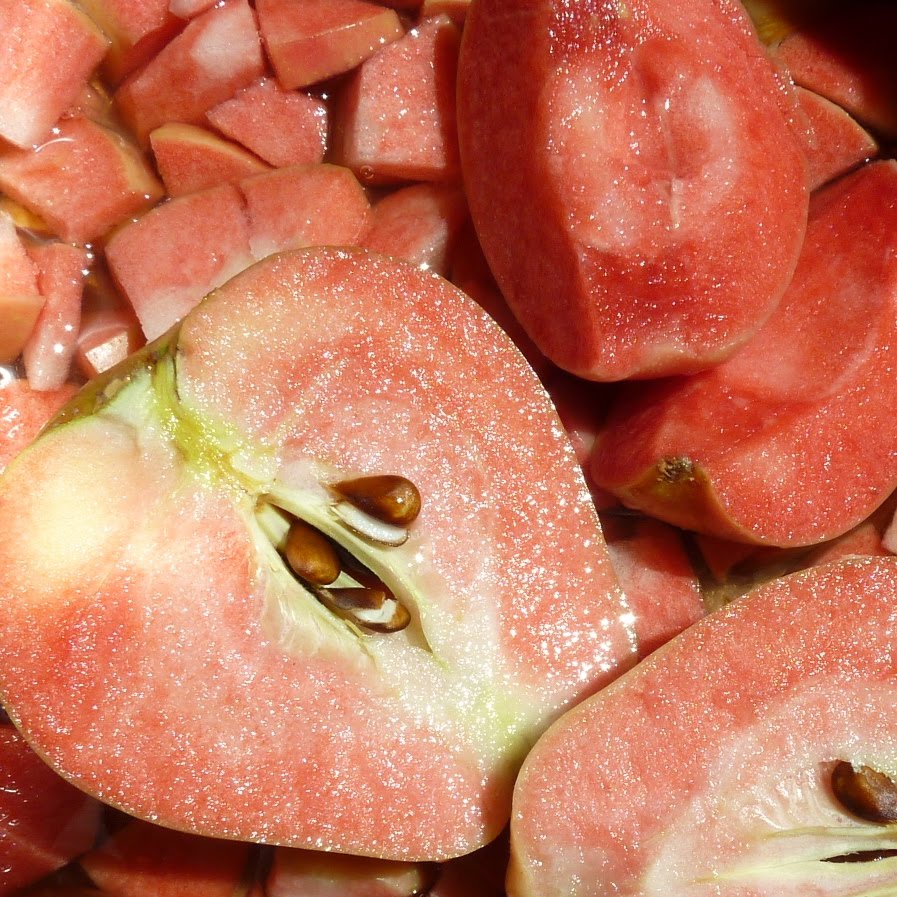
Pink Pearl apples almost all cored and chopped for applesauce.

Canned Pink Pearl applesauce ready for one of our previous Winter.
And I thought, “apple trees come and go just like humans.” Accepting is easy when one embraces cycles of birth, life and death.

This part of Sonoma County use to be mostly covered with apple trees; in fact the very property on which MuRefuge is located was a Gravenstein apple orchard. Most of this area was the same until the land was divided into much smaller parcels, like the six 3/4 acre parcels here at the West end of our road,  or ranging in size up to several acres.

To our delight the nearly 50 acres abutting the West most house on our gravel road has become Green Star Farm.  

Sonoma County has been an agriculture county since it was settled. The “old time” farmers, like the man who owned the old orchards on which MuRefuge is now located, are either dead or retiring. These farmers focused on farming without conscious thought of their practices, farming as they were taught by their parents, so now top soil essentially no longer exists and the nutrients of the soil long ago extracted. Soil regeneration is a hot topic now a day. The young and energetic 2 legged present day farmers are now carrying on the agricultural tradition and are focusing on caring for Mother Earth in ways so all living BEings, including the soil, can thrive.


As each of us considers ways to care for Mother Earth, may we 


Saturday, November 7, 2015

Choices at MuRefuge for Supporting Her Restoration


A foggy Fall morning with small droplets of water hanging
on this gloriously beautiful spider web shows off
the work of this very large spider that lives here at MuRefuge.
‘Yankee Point’ (Ceanothus griseus horizontalis) is the
vibrantly healthy shrub on which the web is woven.

As the plants, animals and land here at MuRefuge slowly and methodically reveal their long held knowing, my practices of restoration are likewise evolving. By altering my own attitudes, beliefs and behavior, thus allowing me more internal flexibility, the land's ecological wishes are honored. The process therefore has recently included removal of two-thirds of the lavender bushes and all of the rosemary bushes from our septic mound. Mostly the honey bees, native to Southeast Asia, enjoyed the nectar from these plants; neither the nonnative bees nor plants supported the life cycle of any native BEing here at MuRefuge or for that matter the surrounding territories.
Native Pollinators rather than Honeybees

When faced with what to plant on our septic mound when we first moved to MuRefuge, I chose rosemary with blue flowers for the Southwest end and pink flowering rosemary for the Northeast end.The honeybees loved the flowers. As I learned that honeybees are actually very lazy pollinators compared to the native bees, I began to rethink the massive plantings. 
I have heard from many reputable sources that native pollinators are far superior in doing their job of pollination than the Southeast Asian honeybees. So several years ago the pink flowering rosemary bushes were removed and recently the blue flowering ones as well.

As the lavender bushes, also planted on the septic mound, flourished, I was looked for a way to share the abundance of the  lavender flowers. I contacted the owner of Sceamin' Mimi's, Maraline Olsen, to see if she would like to make lavender ice cream. She said "yes" and also wanted to know if I had any recipes since she had not ever made lavender ice cream. As many of you know their lavender ice cream is now highly sought after, and has won almost as many awards as Mimi's Mud. Since they do not use an organic "mix" for their ice creams and my body is pretty picky when it comes to what I put into it, lavender from MuRefuge is no longer making its way to this local ice cream shop. So about two thirds of the lavender bushes have also been removed from the septic mound, leaving enough for use here at MuRefuge: in salve for its healing properties, in closets and drawers to deter pesky insects, and to hang in the Great Room for its beauty and fragrance.

Another example of the knowledge gleaned from Permaculture:
chipping all of the rosemary and lavender bushes
provides an abundance of carbon for redistribution on the soil here at MuRefuge.

Three Sisters

With the success of the Three Sisters (bean, corn, squash) planting experiment this year, more space is needed is needed to expand upon the learning. Where the rosemary has grown for 20 years fava beans will be planted atop the septic mound as a cover crop and for mulching. In several small areas about the septic mound native plants communities have been planted. The plants chosen will provide not only nectar for the native pollinators but over time will create beautiful ecological niches for a variety of native BEings who have inhabited this area long before humans.

"We abuse the land because we regard it as
a commodity belonging to us.
When we see land as a community to which
we belong,
we may begin to use it with love and respect."
A Sand County Almanac (1949)
Aldo Leopold

Confetti Bed

  
What has been called the Confetti Bed has likewise been replanted with native perennials and shrubs, a hedgerow of sorts. The borage, calendula, edible chrysanthemums, pineapple sage are grown for their edible flowers and are depicted below in a picture of the present miniaturized variation (minus the calendula) that is now by the veggie garden gate. The edible chrysanthemums are an annual. When seeds are scattered each Spring, the flowers not only have solid yellow petals, as pictured below, but white with yellow tips petals. None of these plants are native. They were chosen for their culinary use. The native pollinators seem to enjoy their nectar as well.


The blue, red, yellow plus the orange of the calendula makes a beautiful edible confetti for fruit or veggie salads, or for sprinkling onto a frosted cake or for scattering atop Summer sorbet or ice cream. The favor is subtle and the fragrance divine.

The hedgerow, of sorts, is comprised of, from West to East:
  • Oregon grape (Berberis aquifolium)
  • Hummingbird Sage (Salvia spathacea)
  • Snowdrop Bush ((Styrax redivius)
  • California Fuchsia (Epilobium c. Chaparral Silver)
  • California Wild Lilac Maritime Ceanothus (Ceanothus m. Valley Violet) x 2
  • Evergreen Currant (Ribes viburnifolium) x2
  • Coast Silktassel (Garrya elliptica 'Evie') 
  • California Wild Rose (Rosa californica)
  • California Fuchsia (Epilobium c. Schieffelin's Choice)
  • Fireweed (Epilobium angustifolium)

This 'Carman's Gray' in full bloom located in MuRefuge's front coastal prairie
provides nectar for the year round Anna's  Hummingbird.


Medicinal Bed

Early on in MuRefuge's creation when I was focused on healing, a medicinal herb bed was created. Agrimony, Feverfew, Marshmallow, several varieties including a native Mugwort, Tansy, Valerian, and Vervain were all planted and flourished, especially the Mugwort which invaded beyond the borders of this bed to become a "ground cover" when mowed.


The burr like seed pods of the Agrimony easily imbedded in the fabulously silky, soft, long fur 
of Rose's ears. Even though she was extremely patient as these were teased out of the fur, the Agrimony plants were all removed from the Medicinal Bed.

Over the years most of the medicinal herbs have disappeared for one reason or another with the exception of Tansy which is hung in closets or laid in drawers to deter predatory insects, and the small button like yellow flowers makes a lovely addition to dried arrangements. Recently all of the Mugwort was removed, the area sheet mulched with chips from the pile on MuRefuge's driveway depicted above. Through the sheet mulching a new plant community was planted:

               Along the East veggie garden fence:
  • Coastal or Narrow leaf Milkweed (Aesclepias fascicularis)
  • Showy Milkweed (Aesclepias speciosa)


After reading recently Susan Wittig Albert's blog post on Lifescapes about nonnative milkweed and the lethal effects on Monarch butterflies, a choice was made to increase the native milkweed growing here at MuRefuge. 'Davis' Showy Milkweed pictured above is not only beautiful when in bloom but extremely fragrant as well.

Then another choice was made to add another plant community between the newly planted milkweed and the well established White Sage (Salvia apiana):
  • Douglas Iris (Iris douglasiana) 
  • Nodding Needlegrass (Nassella cernua)
  • Coyote Mint (Monardella villosa c. Russian River)
And when the Beach Asters (Erigeron glaucus) and California Asters (Aster chilense c. Point Saint George) that are sprouting from MuRefuge's own seeds in the greenhouse have grown enough to thrive outside, they will be added to this community.

Ceanothus and Coast Silktassel Bushes

In the front along the West fence late this Summer I did a long overdue clean up. Oh my gosh, now I remember the plan some ten or probably more years ago of planting Coast Silktassel (Garrya elliptica) bushes some 8 feet apart and in between a variety of ceanothus (also know as California Wild Lilac). My thinking at the time was that as the ceanothus died (they are a relatively short lived shrub), the Silktassel bushes would grow into and fill the space created by the spent Ceanothus. During the long overdue clean up that is exactly what was found. "BEing Rooted and making choices honoring the plants create over time a thriving habitat," I thought to myself.

Gophers

Over the time BEing Rooted has evolved, many of you have asked how to get rid of  gophers. When beginning to put roots in here at MuRefuge, we (both 2 and 4 leggeds) went about killing off the gophers. The picture below is of 10 month old Sun and her 2 1/2 years old sister Star.
 When we moved to MuRefuge, led by Star they took it upon themselves 
to be the gopher patrol. Sun perched on one end of a
 gopher tunnel and Star on the other. They would dig
 towards each other until a gopher was caught. Star would play with it until
 the gopher was dead then Sun would gobble up the organic meat.
 Star was not into eating gophers! In this manner they trapped over their first year here
 some 50 gophers. Dwight trapped with cinch traps
 almost as many.


The above picture was taken soon after we began inhabiting MuRefuge. The decorative white picket fence has been removed but the fence white posts remained until my stepfather, Steve, came in the Fall and painted all of them. And in the background you will notice trees. These very old apple trees were gorgeous in their Sping flowering. Unfortunately only a few years after we began BEing Rooted here, the trees were all removed.


Of course, as you can see in this picture of Sun sitting in one of their digging for gopher events, the catching of gophers surely changed the landscape.

As these two 4 leggeds passed and a different breed of dog came to BE at MuRefuge, our relationship with gophers changed. I remember talking with a woman who brought organic fresh cut asparagus and organic, perfectly ripe peaches to the Original Farmers Market in Santa Rosa ("Do not squeeze the peaches," she would say to everyone visiting her booth and picking up a peach). I asked her about how she dealt with gophers. She said there was enough for everyone, gophers included. At the time I thought that a bizarre way of looking at gophers AND now I completely embrace her point of view. I plant clover and nasturtiums aplenty for their eating enjoyment. MuRefuge does provide enough for all BEings who inhabit or visit her.


Now we have Jax who sits patiently by an obvious gopher hole waiting for one to pop out; then he catches the unsuspecting BEing. I have watched him delicately consume the entire rodent in short order. He leaves the head and, like Sun did, the teeth of his freshly caught and eaten gopher.

Of course, native perennials and shrubs are planted in gopher baskets to give each plant an opportunity to establish itself. The native bunch grasses are planted directly into the ground. This practice has evolved and now has been done for a number of years. I find the gophers nibble on the roots but since they are so massive they do not kill the native grasses.

As we consider making conscious choices, rather than those driven by habit, may we each


Thursday, September 23, 2010

"Fifth Season" when native plants rest Talk with Rainy Tour


This past Sunday a few inquisitive, hardy souls joined me at MuRefuge for a talk sharing thoughts about BE-ing Rooted here in the Mediterranean Biome (see previous post for information about this region).  We gathered inside for talk then ventured outside to the garden and rain.  Here are some pictures Harmony
Susalla.  Through www.harmonyart.com  you can read about Harmony's adventure into the fabric design world and see pictures of her lovely organic fabric.


Dwight's sculpture amidst rhubarb


Raindrops on the showy native clematis by MuRefuge's front entryway


Vegetable beds in transition from old recycled redwood to cinder blocks which will  hopefully deter gophers


Perennial sunflowers in bloom


New Evening Primrose plant


View of MuRefuge looking West from South patio