Pages

Monday, April 25, 2011

Babies and Transplants


Been ages since I have written a new blog post!  The past month or so has 
been all about readying for the Spring burst which has clearly arrived at 
MuRefuge.
  • Completing the dispersing of 8 cubic yards of wood chips which came from
  • a Winter storm toppling our 16 year old curly willow to various path renewals
    and remulching some areas.
Before

After

  • Transplanting from “flats” what I thought would be a few tomato starts and
  • resulted in 95, yes 95, soon to be productive tomato plants.  Here I must add
    that all those tomato plants will not be planted here but given to some dear
    friends and family, and sold for $4 per 4 inch pot at the SCA’s Gardens with 
    Sculpture Tour happening on May 22 from 10 A.M. to 5 P.M.
  • Setting out Todd planters in the garden to acclimate to the out of doors with
  • planting into our fabulously reconstructed vegetable beds.
  • Planting native annuals mostly but a few perennials too out into different
  • spots at MuRefuge thus emptying Todd planters for veggie starts awaiting
    in flats.
  • Transplanting vegetable, herbs and flower starts to Todd planters.
Veggie, herb and flower starts in the greenhouse
Pimento Peppers

Basil starts in foreground
  • Weeding, lots of weeds to fill up our spiffy, thanx to Dwight, compost bins.
  • Vickie, weeder extraordinaire, spends a lot of time on her knees pulling all
    those errant weeds, many of which are invasive European grasses found
    choking out even the invasive Feverfew which I have become to enjoy as
    mowed ground cover.
Our duck flock seems fluid right now.  The 3 oldest Fawn and White Indian Runner females have 
been reduced to only 1.  She is well over 7 years old and has had no easy time adjusting to the loss 
of her sisters. With the support of a Grief flower essence preparation she now seems content to 
hang out with the 4 who are past their 4th birthday and no longer each laying an egg each day.   
So on Earth Day our latest 2 ducks were born, arriving at MuRefuge this past Friday.  For a few 
weeks they will reside in a big cardboard box with wood shavings covering the bottom and a hanging
heat bulb for warmth.  Since we have some difficulty distinguishing older and not as old ducks from 
one another, our newest addition are Chocolate Indian Runners, females of course, from Metzer
Farms in the California Central Valley.  Check their informative web site  metzerfarms.com


Welcome to MuRefuge


Organic food top left, water on the left with a
brick to keep them from swimming in the
water and getting cold, red on left is
the heat bulb


Babies in grass


Three days old
Both the native coastal iris and their hybrids are in full bloom as well as the Eastern Sierra native iris.  How spectacular!!


Happy Spring!  and remember to

  
Comments are welcome!

Saturday, March 19, 2011

Celebration

In the wake of the recent disaster in Japan and in an effort to quiet my self preservation instinct I am focusing on celebration.  This week the first of the migratory hummingbirds showed up at our feeders. Allen's hummingbirds are just so gorgeous!  A pair chase each other about our Roger Red grape vines, sitting for Dwight and I to have a close look at them.
The recent issue of Fremontia: Journal of the California Native Plant Society was filled with celebratory articles.  The most astounding related a discovery amidst the revamping of Highway 101 near the Presidio of San Francisco.  The presumably last wild, previously thought extinct, Franciscan manzanita (Arctostaphuylos franciscana) was found and moved through unparalleled conservation efforts.  Human BE-ings from various, and often cantankerous, organizations were able to pool their resouces to successfully relocate the "ten ton plant and soil monolith".  Clearly a cause for celebration!


The many varieties of California Wild Lilacs (Ceanothus) are blooming. 


Celebration continuing . . .


And there are the flowering currants and gooseberry bushes, too.


More celebration . . .


Before these last series of rain storms, Dwight was able to almost complete the rebuilding of the compost bins so Vickie and I can fill the bins with weeds.
Celebration of Dwight's nature!


As Dewitt Jones' encourages in his CELEBRATE WHAT'S RIGHT WITH THE WORLD! http://blog.celebratewhatsright.com/ may we each in our own way
give celebration.  


This Sharp-shinned Hawk gives celebration for the many birds who visit our shelled sunflower bird feeder that might provide breakfast?


Celebration of the natural cycle.


As you each
please consider sharing in the comment section below your own celebration.

Saturday, March 5, 2011

Spring's Happening

Rain and pleasant weather is the pattern, hopefully those freezing nights have passed but that is not likely just yet.  The stone fruit trees are in bloom unfortunately there is not a pollinator to be seen, although Saturday I saw a Mourning Cloak butterfly on our walk along Willowside Creek.
Dwight has been cleaning out and refurbishing old nesting boxes as well as building new ones from recycled lumber.  We are hopeful that birds will move in and successfully raise their young.


Chickadee Nesting Box

Western Bluebird Nesting Box


Northern Flicker Nesting Box

Nuthatch Nesting Box

In the open field to our South not long ago I noticed Turkey Vultures circling and landing.  My curiosity had me climbing over the fence and walking up to see what lay on the ground . . . a dead doe.  And not far away a pair of grey foxes were playing.  It has taken the dozen or so Turkey Vultures about two weeks to clean the carcass.
And a few afternoons ago I saw in the same field, what I thought at first was a fox but then a tail with circular strips shot up in the air.  With my binoculars I could see the pointed ears of a bobcat which lounged about in the grass for some while.
We often take Rose to Shollenberg Park along the Petaluma River for walks.  A few mornings ago we were fortunate to see a River Otter swimming and diving in the river.  We are pretty sure it was a male since he was so large that at first we thought it was a seal.  “How cool is this?” we asked each other.
With all the rain the soil along the South perimeter of our property is saturated hence we have a running creek.  Rose loves to play in it.  While she is having her afternoon nap, the ducks enjoy foraging along the narrow waterway and into the grass, under the bushes.  With all the food they forage they barely eat any organic laying pellets.  And we have been gathering an egg each morning now for a few weeks.


Many early blooming natives are in flower here at MuRefuge.  Here's photographs of just a few.

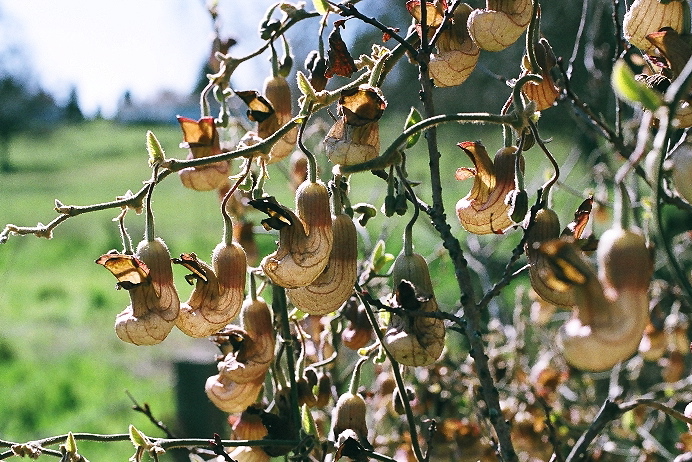
Aristolochia californica (California Pipevine)

Carex nudata (California Black Flowering Sedge)

Arabis blepharophylla (Coast Rockcress)

Ribes speciosum (Fushsia flowering Gooseberry)
Arctostaphylos densiflora ‘Sentinel’

Garrya elliptica male variety ‘James Roof’ (Coast Silktassel)

I would love to hear what is happening at your place.  Comments are appreciated while you


Saturday, January 22, 2011

This n' That

Early in January we completed our vegetable bed make over
using basalt blocks purchased at and delivered by Friedman’s.
The older beds with old growth redwood were replaced and
three additional beds were built from scratch for artichokes, 
and for tomatoes and asparagus which are great companion 
plantings.


The seeds I ordered have arrived.  FYI I ordered from the below 
companies


The fallen curly willow received attention with the smaller branches
and twigs chipped separately and carried away.  These parts of the 
tree would have easily sprouted to give us gazillions of  curly willows.  
We have a luscious pile of chips awaiting application to the land.


The root will be chipped and the fence rebuilt once the area dries out. 


2011 talk/tours at MuRefuge:
Sunday, April 10 
Sunday, June 12
Sunday August 14
Each one will be from 1:00 pm to 3:30 pm, a change from last year 
when the mornings were so over casted and chilly for our time together.  
Hopefully this new time will be amenable for those of you wishing to 
attend.
The focus, of course,  will be on California natives.  You can check out the 
updated plant list which appears in the previous blog post.  If you would
like to have a plant list during the talk/tours please download the plant
list from this blog.
As in 2010 space is limited for each talk/tour so please register
by emailing me at  afsp@sonic.net
Directions will follow for those unfamiliar with MuRefuge’s location.
As last year the “fee” for attending is one bag of Organic Fox Farm 
Potting Soil.
In addition to the above dates, you may visit MuRefuge on May 22 by 
purchasing a ticket for the Gardens with Sculpture Tour which is a 
fundraiser for the Sebastopol Center for the Arts.  As the title of the 
tour suggests, sculpture will be for viewing and purchase.  Also, 4” pots
of California natives and edibles will be available for purchase, also.
40% of the proceeds will benefit the Sebastopol Center for the Arts.
AND, at 11 am I will talk about Backyard Wildlife Habitat through the
National Wildlife Federation and at 2 pm about the North America 
Butterfly Association’s Butterfly Garden and Habitat Program.
As, the date for this event nears more information will be forthcoming.
Even tho’ we are having warm sunny weather, it is still Winter napping is good and 
comments are appreciated.


KEEP LAUGHING


Saturday, January 15, 2011

Precious Water

MuRefuge’s landscape has been recently altered first by moving manzanita to the West of the “Give Peace a Hand” sculpture, second by cutting down three Douglas Fir trees for Christmas, and third by the uprooting by a huge windstorm of the curly willow on the Southwest corner of our property near the artisan well.  


And my internal landscape over the 2011 transition was purged when I contacted the flu.Thus an opportunity has been presented to allow different choices for both in choosing MuRefuge’s plantings and fuel for my human form.
While considering choices, I recall Chief Seattle’s quote
Humankind has not woven the web of life. 
We are but one thread within it. 
Whatever we do to the web, we do to ourselves. 
All things are bound together. 
All things connect.
and I feel compelled to make choices that will support a healthy, healing
web of life not only for the humans inhabiting MuRefuge but for all the other creatures who call this place home too.


With all the rainfall we have experienced thus far this rainy season the artisan well is running constantly.  Observing this artisan well brings to the fore how precious water is and how diminished our water table is.  When we first moved here California was amidst a drought and there was no evidence of an artisan well.  Then more abundant rains occurred and water was running up into the electrical system of our well’s pump.  Rerouting the water flow seemed prudent.

Dwight created a lovely set of cupped hands to catch the artisan well water before it flows into a very small pond.  


This small pond remained until about three years ago when the artisan well stopped flowing in late Spring, not reoccurring until the rain resumed.  The curly willow lost all of its leaves as did all of the native moist loving plants nearby.  This stopping and resuming has brought my attention to all of the individuals’ wells in the area.  Some of these wells are watering vineyards recently planted and washing fire trucks, others are keeping lawns green during the Summer, while a few of us are focusing on water conservation in a mirad of ways.


How long will our water table support us?  And might we learn from the story unfolding in the Eastern Sierras?

MONO LAKE

In the early 70’s, I was living in Sacramento with my Lakota (well 50% Lakota and 50% Canadian fir trapper really) former husband who was beginning to question the “white” upbringing his parents had chosen for him after leaving the Rosebud Indian Reservation.  We became involved in establishing Indian Studies at Sacramento State University.  I took one of the early classes on the history of water in California where I learned of thirsty Los Angeles, their quest to quench that thirst, and the arid destruction left in the wake.
It was in this class that I first heard about Mono Lake.  In Ted Konigsmark’s Geological Trips: Sierra Nevada on page 124 there is a black and white photograph from the Mono Basin Visitor’s Center showing the horizontal lines along the lower part of the the Sierras that define the old shoreline of Pleistocene Lake Russell some 600 feet deeper than the present Mono Lake.
Not until the late 80’s, driving East on Tioga Pass Road, did I actually see Mono Lake.  Upon my first glimpse I must say I had one of those “Aha“ moments resonating through each cell of my body.  All that ancient energy being held in the basin seemed to flow into my BE-ing.
I have had many such experiences since my first viewing of Mono Lake after BE-ing at MuRefuge.  Now this first view “Aha” usually happens driving over Conway Summit and stopping at the pull out for viewing Mono Lake.

In 1941, the tributaries of Mono Lake began being tapped by the Los Angeles Department of Water and Power, which had already sucked dry Owens Lake.  By 1982 Mono Lake had dropped 45 vertical feet losing half of its volume with a doubling of the salinity.  Since the lake is on a major flyway for millions of migratory birds, as well as the major nesting sight for the California Gull, the health of the lake and its inhabitants of brine shrimp and shoreline alkali flies are crucial food sources.
The birds and animals, trees
and grasses, rocks,
water and wind are our allies.
They waken our senses,
rouse our passions,
renew our spirits and
fill us with vision, courage, and joy.
David Gaines
Mono Lake Committee Founder

The Mono Lake Committee founders conducted the first ecological study of Mono Lake in 1976 and two years later this nonprofit citizens’ group was founded.  This grassroots organization is “dedicated to protecting and restoring the Mono Basin ecosystem, educating the public about Mono Lake and the impacts on the environment of excessive water use, and promoting cooperative solutions that protect Mono Lake and meet real water needs without transferring environmental problems to other areas.”

The Committee has worked with focused intent to protect Mono Lake from excessive water diversions to Los Angeles. Their efforts of litigation, legislation, cooperation, education and most importantly, public support have been successful thus far. 


These next three photographs are of posters in the bathroom at the Mono Lake Committee Store in Lee Vining educating all who use the facilities . . . examples of "education":


I am humbled to be a tiny part of this ever vigilant group of dedicated BE-ings.  Their efforts to reeducate the inhabitants of the Los Angeles Basin has been nothing short of miraculous!  The city of Los Angeles has gone from one of the most water guzzling cities of the United States to one of the most conservation minded.  
Southern California children come North each Summer to experience the wonders of the Mono Lake Basin and often to work on the many restoration projects.  These efforts are evident on the Lee Vining Creek walk from the South side of Lee Vining to the Mono Basin Visitor’s Center.  Hiking along this trail now it is hard to imagine that a few years ago hundreds of discarded tires littered the creek bed.

MONO LAKE COUNTY PARK
A must see is Mono Lake from the Boardwalk at the Mono County Park, land leased from the Los Angeles Water Board where you see signs saying so.  We have spent many enjoyable afternoons in the park basking in sun after a picnic.  It was one of Star’s very favorite places!  And at all times of the year we have met visitors from Germany, Japan, France enjoying their picnics, too.
Just before Leigh and Steven were forced to depart early from our marriage celebration because of a predicted snow storm the following day, we all piled into automobiles with our jackets, hats, scarves, mittens/gloves, boots.  After a hike along the West side of Mono Lake and on our way back to Bridgeport, we stopped.  Here are some pictures:


MONO LAKE from Test Station Road
One of our favorite hikes is along the West side of Mono Lake accessed by turning left off Highway 395 at the Test Station Road turnoff, just past the Lee Vining Airport.  (Yes! Lee Vining has an airport as does Bridgeport!)  As the road goes downhill a Y occurs.  Turn left and very soon you will be on a gravel road.  From the Y it is about 2.5 miles to the road’s end at Lee Vining Creek.  Walking along this deserted road any time of the year offers spectacular views in all directions.  We’ve seen the full moon rise, awesome light shows (similar to the aurora borealis further North), lenticular clouds forming before our very eyes, glassy water to white caps on Mono Lake, and sky blue to mossy green color diversity.   
Here are some pictures taken over the course of 10 days or so on our most recent sojourn to the Eastern Sierras:


MONO LAKE from Lundy Canyon Road
Another of our favorite hikes is along the South exposure of Lundy Canyon.  The road runs up the canyon with the creek flowing along the North exposure.  A manmade water catchment system has been constructed along the South exposure so there is a very rudimentary road right out to the tip where there is a fabulous view of Mono Lake.
After all the family and friends departed, one afternoon Dwight, Rose and I took this walk.  Here are some pictures:


I am reading An Extraordinary Year of Ordinary Days by Susan Wittig  Albert.  Among today’s notes appears a quote by Charles Darwin: 
It is not the strongest of the species that survives, 
nor the most intelligent that survives.  
It is the one that is the most adaptable to change.”  
Perhaps taking a few moments to reflect upon this would be instructive? 
Comments are appreciated particularly in regards to the state of our precious water.
KEEP LAUGHING