Pages

Monday, June 13, 2016

Human Silly-ness, aka "Progress"


Farewell to Spring (Clarkia amoena)
“When will we give up the artificiality of 
our tiresome lives 
and cleave instead 
to what is natural? 
All the achievements 
of man are only monuments to overwhelming pride. 
There has not been a single man-made item 
that has been a necessary improvement to the earth. 

We don’t need all this ‘sophistication’ 
in order to live with Tao. ... 
We ignore the natural order of our own bodies and minds 
and close ourselves ... 
We lament that we are lost and alienated. 
Ironically, the answers are right nearby. 
If you just go to the nearest tree and contemplate, 
you will easily see the secret to natural living.” 
Tree, 365 Tao Daily Meditations, Deng Ming-Dao, 1992.

In April I went to a well attended event at Tara Firma Farms located West of Petaluma in the hills then still a vibrant green and the air washed the previous day by a late rain brought by El Nino conditions.

Joel Salatin, whom I first heard speak many years ago at one of the early Bioneers Conferences in San Rafael, and Paul Kaiser, co-owner of Singing Frogs Farm, right here in Sebastopol/the “West County,” were the speakers that drew me to attend. There were other speakers, of course, including  Mark Squirethe new owner of Tara Firma Farms, which previous to registering for this day I did not know existed just a short drive from MuRefuge.

Joel is an entertaining and incredibly informed speaker. This perfect place: sunny, warm, with a gentle breeze wafting over all of us sitting on straw bales in a green pasture, AND Joel sharing his insight gleaned through observation, experience and historical reading . . . what a wonderful afternoon spent. The information he expounded upon about the nature of grass and the activity of migration herds back before Europeans slaughtered the Bison into almost extinction brought into focus our human silly-ness. The relationship between the native grass prairies and the migrating Bison reminded me once again how Perfect Wild Nature is.

Grass in its “baby phase” and its mature phase when the seeds flourish and ripen have little nutrition for such four legged mammals as the Bison and cattle. It is the “juvenile phase” that provides the maximum nutrients for these BEings.  When huge numbers of Bison inhabited North America, they migrated, starting in what is now Mexico onto the United States grasslands and up North into Canada and Alaska. The native grasses of these regions differed in grass species but all were native to the specific region. Joel shared from one of his readings of early explorers/settlers their witnessing Bison covering an area 50 miles in length and 20 miles in width; another documented millions of Bison seen all in one area.

There are groups of people today who say there are too many such animals living on the planet polluting our atmosphere. In actuality the present day numbers are minuscule compared to those existing before the pre-European explorers. The belief of Joel Saladin, and mine as well, is that it is not the number of cattle but rather the human silly-ness (of course, Joel did not use this phrase) of the present day agribusiness practices used in raising these animals: containing these animals in feed lots and feeding them grain that the cattle cannot digest.  How many of you have eaten dairy, grains or some other food that you could not digest and your became bloated with much ensuing gas eliminated. Well, cattle react similarly to grain. Grass, especially juvenile grass, is much more easily digested. Thus cattle are now labeled as a major cause of greenhouse gases in the form of methane. There is also the issue that these animals are often unhealthy and carry diseases which after they are  slaughtered and consumed by humans can cause illness or possible death.

When I went to nursing school in Omaha, Nebraska when the stockyards still were in existence, the smell often wafted to the area where the school was located. My stepfather always said the smell of manure was the smell of money. Well, the smell of the manure from the stockyards and from his pig farm was so much less offensive than the smell of the present day feedlots . . . oooohwheee!!! The smell of the present day feedlots is 1000% more odiferous than the stockyards of 1960's.

In the distant time of huge Bison migrations, the herds ate the green nutritious grass of the low lands near water, then at nighttime moved upland to minimize the predation of its members by wolves. As this Wild Nature behavior took place, the urine and feces elimination took place on the hill tops feeding the soil upland rather than accumulating in the lowlands near the water sources, demonstrating yet again the ingenuousness of the Wild Nature of the Bison to the health of the land. In tune with their natural instincts the health and wholeness of the planet was not compromised as they are by the present day human silly-ness of feedlot beef. 

Sad but true, the only remaining remnant of massive hoofed four leggeds migratory behavior exists in the Serengeti National Park in Tanzania, Africa.

This picture of the migrating Wildebeest was taken 
by our friend, Steve Sweaney,
 earlier this year in February when he and his wife,
Judy Withee, spent a few weeks in the Serengeti.
Human silly-ness was exemplified last week as monstrous sized equipment arrived in the fields South of MuRefuge. The agribusiness equipment was so large it could hardly be turned around in the small fields. This massive equipment was a first we have witnessed for the harvest of hay which has been occurring in the late Spring/early Summer for years. These huge "toys" fueled by petroleum add mightily to greenhouse gases.

This agribusiness equipment reminded me of the saying, “the difference between men and boys is the size of their toys.” 

I grew up in the Southwestern corner of Iowa not far from the Missouri River. Living there I saw much hay cut and baled, some years even participating in the process. The bales were picked up by humans and stacked on wagons to carry them for storage in a barn. This monstrous array of equipment used here included a machine to take these huge bales, probably the size of nine of the old time size bales, and shrink wrap them in plastic. This particular harvest of hay has been in the past, and I assume will be this year as well, used to feed dairy cows designated as organic. Plastic  is not organic!

This is Dwight standing next to a shrink wrapped hay bale in the field South of
MuRefuge. Beyond the Oregon Oak trees is our house.
"What if . . . the whole construct of human progress is a sham?" 
Scents and Sensibility, Spencer Quinn, 2015.

This quote reverberates and rings true me as I look out onto the golden field of mowed grass to the South of MuRefuge dotted with the huge shrink wrap hay bales.

The other speaker who drew me to Tara Firma Farms was Paul Kaiser, the co-owner of Singing Frogs Farm, who proclaims himself to be a geek. Paul  and his wife Elizabeth’s focus on their farm is feeding the soil so that it is alive and vibrant, which in turn grows alive and vibrant food sold right here in the West County (of Sonoma County, California). He is mesmerizing to listen to as he expounds on the research he has read and internalized, as well as on the implementation of healthy soil practices at Singing Frogs Farm.

It is helpful to know that Paul does not come to farming from an agriculture based education, rather he immersed himself in forest restoration. The concepts he learned he now applies to restoring the soil at Singing Frogs Farm.

One of Paul’s loves is planting woody plants which provide year round “homes” for beneficial insects, aka good garden bugs, since these plants have flowers over an extended period of time. He shared that most predatory insects, aka bad garden bugs, flourish on annuals, plants that all flower at the same time. So if one has a garden to feed humans, what a glorious idea to plant native flowering bushes and perennials. By choosing and planting many different varieties of native plants that each flower at different time of the year near and/or around your vegetable garden, fruit trees and berry bushes, you support the life cycle of native pollinators (of which there are over 19,000) and other beneficial winged creatures. By offering year round habitat for these beneficial insects one can usually minimize the destruction of your berries, fruit trees and vegetables by the predatory insects, or bad bugs. Diversity and balance is the key. It is the way of Wild Nature and perhaps a way to minimizing human silly-ness.

California Wild Rose (Rosa californica)
“I’ve been having my morning coffee 
out on my back porch. 
Previously, I would have it in front of the computer 
while checking email or browsing Facebook, 
but this morning I was struck by all there was to see. 
Birds in and out of the tree, 
a bee collecting pollen from my drooping sunflower, 
squirrels calling to each other 
and racing along the power lines, 
gorgeous clouds nearly covering 
the deep blue end-of-summer sky. 
There was so much movement and so much noise ... 
I noticed as I came in this morning 
that there was a small smile on my face 
rather than a furrow on my brow. 
I hope to carry the peace with me through the day. 
And now I want to tell everyone, 
‘Just go sit outside! 
Do you know what’s out there? It’s amazing!’ 
But then I think ... 
it seems to be the kind of thing, 
perhaps like faith, 
that you just can't force upon another. 
You can live it 
and revel in it 
and be available 
when someone comes along 
and says ‘what’s the fuss all about?‘ 
But you just can’t force a person to be amazed 
by the chaotic dance of some unidentified insects 
in the rising sun.
... and if you haven’t already put it in your book, 
one of your days should be 
have your morning coffee outside.‘“ 
Personal email from Jessica McMaken to author. 
Living Earth Devotional: 
365 Green Practices for Sacred Connection, Clea Danaan, 2013.


May our connection with the natural world and its Wild Nature magnify as we 


Tuesday, May 24, 2016

Broody Duck and Other's Wild Nature

This morning when I went out to release the five Indian Runner ducks
from their house and to gather eggs,
this arrangement of eggs in one of the nesting boxes
is what greeted when I lifted the lid on the side of the duckhouse.

One of the Tootsie Rolls, the smallest in size, has been broody for the past couple of months. She often arranges the 2 wooden eggs and the eggs laid by herself and her sisters in one of the nesting boxes. She only sits on the eggs while in the duckhouse and spends her days foraging with her sisters. Indian Runner ducks are not known for their ability to sit on eggs until they have hatched. Although, there was one in a past flock who did so but unfortunately outside of the duckhouse, so just as the first eggs were almost finished their incubation, a night time marauder had her for a meal. 

Welcoming and accepting the creatures and their life cycle as an integral part of MuRefuge and her vibrant web is sometimes trying, as with the gophers mentioned in a previous post. However, the rewards of doing so offers such an array of "wild nature" behaviors which adds  to the wholeness of the landscape of which we are the present stewards.

For months now we have had a male Western Bluebird pecking at the windows that reflect his image. At first I thought he was protecting his family’s nest. However, the behavior has continued long after the eggs have hatched and his offspring have fledged. A few evenings past while lounging in the bath and looking out the window, I could see sitting in the bare branches of the dead curly willow Mom and Pop and two beautiful youngsters. In the dead curly willow just to the East of our East most fence is one of the many bluebird boxes Dwight has built and installed. This particular box must be this bird family’s home. Many Bluebirds used to nest in the many apple trees to our South which were all cut down a few years after we began putting down roots here. Given the loss of old trees in which to nest, we find each year the bluebird boxes are often used by these gorgeous birds.


Native Twinberry Honeysuckle ((Lonicera involucrata).
Not surprising a family of Bluebirds has claimed MuRefuge as
their territory with the abundance of food for their taking.
We have watched Mom and/or Pop feeding one berry at a time to their offspring.
As some of you have read in previous posts, bird tape has been installed on most of the windows to decrease bird collisions. The two windows where the male Bluebird first pecked, the windows were recently reinforced with additional bird tape which over the few weeks has minimized his pecking at his reflection since there is little window pane for him to see himself in. Alas, he has moved to other windows which have a bit more glass for his reflection to be seen. Wild territorial behavior in the winged who has claimed MuRefuge as his territory is a wonder to behold.

Flowering native Wild Honeysuckle (Lonicera hispidula)
which also has berries for the birds to eat.
With the El Nino rains of Spring passed the native bushes and vines have put on a stunning display of flowers this year. Natives to this area seem to be familiar with years of drought and years of an abundance of rain. With the former, plants of all sizes seem to sequester their energy, providing an abundance of seeds for reproduction/survival of their species. With the recent Spring rains the flowers on the perennial bushes, vines and trees have been exceptionally spectacular this Spring, and now the cycle turns to Summer.

The rising sun shining on flowering Cream Bush, aka Ocean Spray (Holodiscus discolor),
which provides nectar for native pollinators.

As we observe Wild Nature all around us during the turning of season, may we each 


Saturday, May 21, 2016

Accepting

Living here in the Sonoma “West County” its human inhabitants understand that gophers, in abundance, live here also. Our neighbors to the West had to replace their above ground swimming pool with a cement pad beneath when the gophers nibbled through the bottom of the pool. And when most perennials are planted at MuRefuge they are installed in gopher baskets.

Gopher baskets give young roots a chance to grow and feed the plant of which they are a part. However, they are temporary after years of sitting in damp soil. Even with many years of drought here the soil still does get damp from the intermittent rains. As the gopher baskets disintegrate and are incorporated into the surrounding soil, the apple trees seem to be the most susceptible to the gophers who apparently like the taste of their roots!

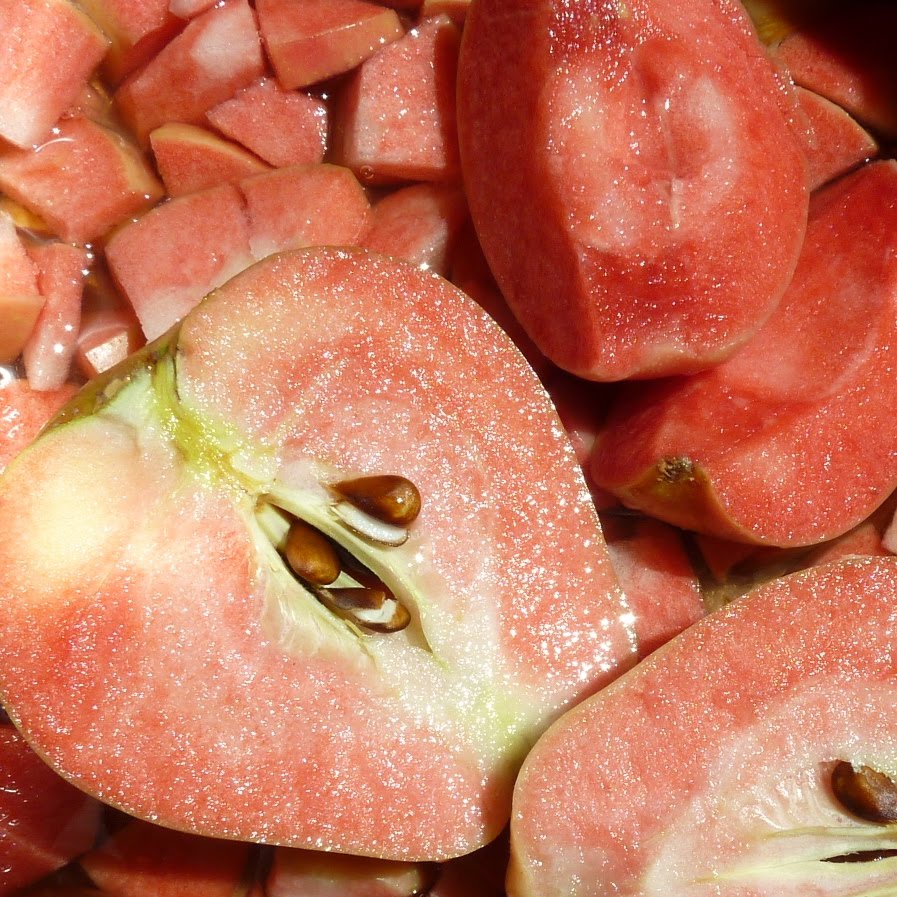
Accepting all that appears at one’s place of setting down roots is by no means easy. Accepting can be simple, however. As I surveyed  this Pink Pearl apple tree a few weeks ago, I noted the foliage was droopy and the little green apple were wizened. Since this is not the first apple tree to have lost its root system to the gophers, I wiggled the trunk: not too wiggly. But once the dead vegetation was removed not much soil needed to be removed from around the trunk before the entire trunk and what was left of the roots system could easily be pulled up from the soil. 

Remains of a 30 year old dwarf Pink Pearl apple tree.
As I set the trunk in the pile to be chipped, I was grateful for all the Pink Pearl apples this dwarf antique apple tree has given us over her many years. 

Pink Pearl apples picked and ready for applesauce making.

Pink Pearl apples almost all cored and chopped for applesauce.

Canned Pink Pearl applesauce ready for one of our previous Winter.
And I thought, “apple trees come and go just like humans.” Accepting is easy when one embraces cycles of birth, life and death.

This part of Sonoma County use to be mostly covered with apple trees; in fact the very property on which MuRefuge is located was a Gravenstein apple orchard. Most of this area was the same until the land was divided into much smaller parcels, like the six 3/4 acre parcels here at the West end of our road,  or ranging in size up to several acres.

To our delight the nearly 50 acres abutting the West most house on our gravel road has become Green Star Farm.  

Sonoma County has been an agriculture county since it was settled. The “old time” farmers, like the man who owned the old orchards on which MuRefuge is now located, are either dead or retiring. These farmers focused on farming without conscious thought of their practices, farming as they were taught by their parents, so now top soil essentially no longer exists and the nutrients of the soil long ago extracted. Soil regeneration is a hot topic now a day. The young and energetic 2 legged present day farmers are now carrying on the agricultural tradition and are focusing on caring for Mother Earth in ways so all living BEings, including the soil, can thrive.


As each of us considers ways to care for Mother Earth, may we 


Friday, May 6, 2016

Respectful


recent Sunday past, as Shasta and I usually do, we were walking on the West County Trail in Sebastopol. And as often happens, others walking their dog(s) stop for our 4leggeds to greet one another. Shasta exuberantly greets humans; however her greeting other dogs varies. One of the dog owners made the comment watching Shasta meeting up with her dogs, “she is so respectful.” That term “respectful” is not a familiar description to me of Shasta, but upon further mulling I can see how this dog owner came up with this word to describe Shasta. 

“The essence of life shall never be known by a human being as long as that person seeks 
to observe life like viewer and subject. The absolutely essential nature of life 
can only be comprehended by merging fully with the flow of life, 
so that one is utterly a part of it.” 
365 Tao: Daily Meditations, “Essence”, Deng Ming-Dao (1992).


Being respectful of others and their gifts, in spite of our individual “point of view” from which we may not understand the other, is part of the “flow of life.”  In the past I was not only skeptical but downright disdainful of one who claimed dowsing abilities until I met and studied albeit briefly with Desda Zuckerman.

Immersion in  her teachings and practicing her lessons, I came to realize some of my own abilities of sensing subtle energy. In my searching for a tool, since the one suggested by Desda did not seem to work for me, I remembered the rutilated quartz crystal that my now dead brother sent to me. I attached it to a chain and began using that as my tool with which to connect with energy of the subtle nature.


Rutilated quartz 
“is a clear crystal that contains rutile fibers that have a golden or reddish color. 
These fibers add even more intensity and transmission power to the crystal 
because they bear cross currents of electrical charges that amplify healing . . .”
Healing with Crystals and Gemstones, Daya Sarai Chrocron (1988)
This is the reason my brother sent the crystal to me
when I was healing from the autoimmune disease in my forties. 

This simple yet powerful tool works for me and I use it in in a variety of situations depending where and when I wish to BE more in touch with this powerful, yet often denied by our culture, subtle energy source surrounding us all. 

When I am preparing flower essence for myself or another BEing, I use the crystal pictured above. The crystal indicates by the direction of circulation a “yes” or “no” which is agreed upon by the user and the crystal, or whatever tool is employed, during the “bonding” of tool and user. Once an essence preparation is chosen and completely mixed for those BEings who have sought a remedy, maybe or maybe not then I might check out what is written in Flower Essence Repertory, Patricia Kaminski and Richard Katz (1994) about the flower essence(s) indicated using the crystal. If I do so, I am often surprised but respectful of the constituents of the preparation. However, once the remedy is used by the BEing for whom it was created, the feedback is positive.

One woman who sought support for the transition of her recently adopted dog who had a traumatic journey arriving at her now “forever home” called the flower preparation mixed especially for her dog a “magic potion.”


In the background and immediate foreground is 
“flowering” Nodding Needlegrass (Nassella cernua)
and the fairy like blooming plant is 
Blue eyed Grass (Sisyrinchium bellum).

Flower essence offers living BEings support and opportunity for transition. Many of you have heard of and perhaps used Rescue Remedy, aka Five Flower, to ameliorate shock. I use this in spray form when I transplant seedlings to minimize transplant shock. The Flower Essence Society In Nevada City, California has built upon the original research done in the 1930s by Dr. Edward Bach, an English physician. This organization has expanding the number of flower essence available for adjusting, healing, shifting the life forces at play in any living BEing. 


MuRefuge’s Indian Runner duck flock: Coco the chocolate duck is in the far back, 
the two Tootsie Rolls are on either side with the yellow bills, 
in front is Miz Crone and behind her greenish yellow bill is Blue. 
When the Tootsie Rolls were introduced to the older ducks, 
the way of ducks was to put these two youngsters in their place in the flock.
 To soothe the transition a flower essence was used for several weeks. 

Just like different plants sequester different elements/nutrients, likewise different flowers possess the ability to shift different life forces. The flower essence offers a BEing support to shift or not. The living organism, if not ready to let go of stuck or cellularly embedded energy patterns, or comfortable and familiar ways of going about in the world, is totally unaffected by the flower essence. The flower essence is inherently respectful of any BEing’s choice.

Another way of checking in with the subtle energy surrounding everything is muscle testing. This simple connection with our muscles strength can be used for deciding whether a flower essence remedy/preparation is the one for you. 

“If you have ever seen applied kinesiology,you have experienced this tool for tapping into the subconscious mind and the energy fields surrounding the body. When something is true, the electric impulses in our muscles fire; when something is not true or doesn’t serve us, the electric field is weakened and so are our muscles. “

To use this technique “make an O-shape out of your thumb and forefinger. Do the same with the other hand, then interlock the two circles. Tug firmly on the little chain shape, not letting the circles break. State something true, such as ‘my name is [your name]’ and tug. Now state something false: ‘my name is Asparagus,’ and tug - your fingers will not be able to hold the chain.”

“This works whether you know the answer or not, as it is based on the integrity of the energy fields in and around your body.” 365 Green Practices for Sacred Connection: Living Earth Devotional, Clea Danaan (2013).
May each of us BE respectful of all BEings, small or large, as they journey on their individual life path and


Tuesday, May 3, 2016

A Belated May Day "Basket"


Beltane, a cross quarter day in the Celtic calendar, is a celebration of the shift from Spring into Summer. Passion and creativity are the focus where paper baskets of flowers are delivered to friends and neighbors, and pastel ribbons are tied to the May pole for children of all ages to dance joining forces to light their passion for transformation.


The flowering native Buckeye tree at MuRefuge.
This tree was planted in Fall, 1994, a "housewarming"
gift from my parents when they visited that year in October.
My belated May Day basket to you is filled with the Buckeye tree's flowers.


As we take this opportunity to become more attuned with our land and support her bounty, may we each


Tuesday, April 19, 2016

Weeding


This is the view from our South facing sliding glass door.
 The mass of flowering Fringe Cups are splendid to behold
in the early morning sunlight.
Fringe Cups (Tellima grandiflora) flowers close up.

Weeding is a “close up and personal” activity which is simple but not easy. Weeds are what a gardener does not want in her or his garden, so the gardener considers the best way to get rid of them. For the Earth conscientious gardener the choice to weed, a simple but not easy activity, is a no brainer when one considers the alternative of spraying weeds with an herbicide. From where do herbicides spring? From factories that produced nerve gas used in World War II is the answer. If one is spraying with a chemical designed to kill a plant that is a living BEing, one might consider what else besides the weeds the spray will affect and realize that there is no such thing as a “safe” and/or “organic” herbicide.  In California now RoundUp must carry a warning that it can produce cancer.

This year with the several months of El Nino rains which meant warmer than usual temperatures for the rainy months here in Northern California there is now a plethora of weeds. Really we had only a month (December) during which we had frost or freezing temperatures. With the warm, abundant rains the seeds in their bank (aka soil) sprouted everywhere and roots of weeds not removed in previous seasons flourished.


Talking with a friend during our walk and his bike ride, he shared he goes out a couple hours in the morning because that is as long as his knees last then rests until after his midday meal then another couple of hours of weeding again on his knees which is followed by another rest until late afternoon when he spends another couple of hours amidst the weeds digging them out on his knees.

My daily weeding routine differs from our friend’s but is done on my knees nonetheless. In this position one is close to the soil and can clearly experience the soil as a living organism pulsating with life giving energy. In most areas of MuRefuge everything goes except the native plants. The most prevalent weeds seem to be an invasive geranium and an equally invasive salvia + of course, the invasive European grasses which crowd out the native bunch grasses.

Let me share: the carbon production from the weeds this season is huge!!!! Wheel barrows after wheel barrows laden with freshly dug out, not only weeds, but their entire root system as well,


are making their way to our very large, and growing every day, compost pile beneath a composting fleece blanket.


Last year all of MuRefuge’s weeds went into a green bin and were picked up by the “garbage company.” At the time all the green waste went to Sonoma Compost where it was composted and then could be purchased for use by anyone in the county wanting to feed their soil. Sonoma Compost has been closed by the Board of Supervisors. And now the green waste from the county is trucked some 300 miles. YIKES! was my reaction when I heard this, and I set out to find an alternative to green bins picked up weekly for MuRefuge’s “green waste.” In Permaculture’s way of viewing weeds, grass clippings, pruning remnants and the like, these are a rich carbon source for feeding the soil and her inhabitants. 

Thus weeding and mulching (this topic is for a later post) is once again in the forefront of activities here at MuRefuge. And for those interested in learning more about the process using the composting blanket here is a link to an article written by the owner of the company from whom we purchased our blankets.

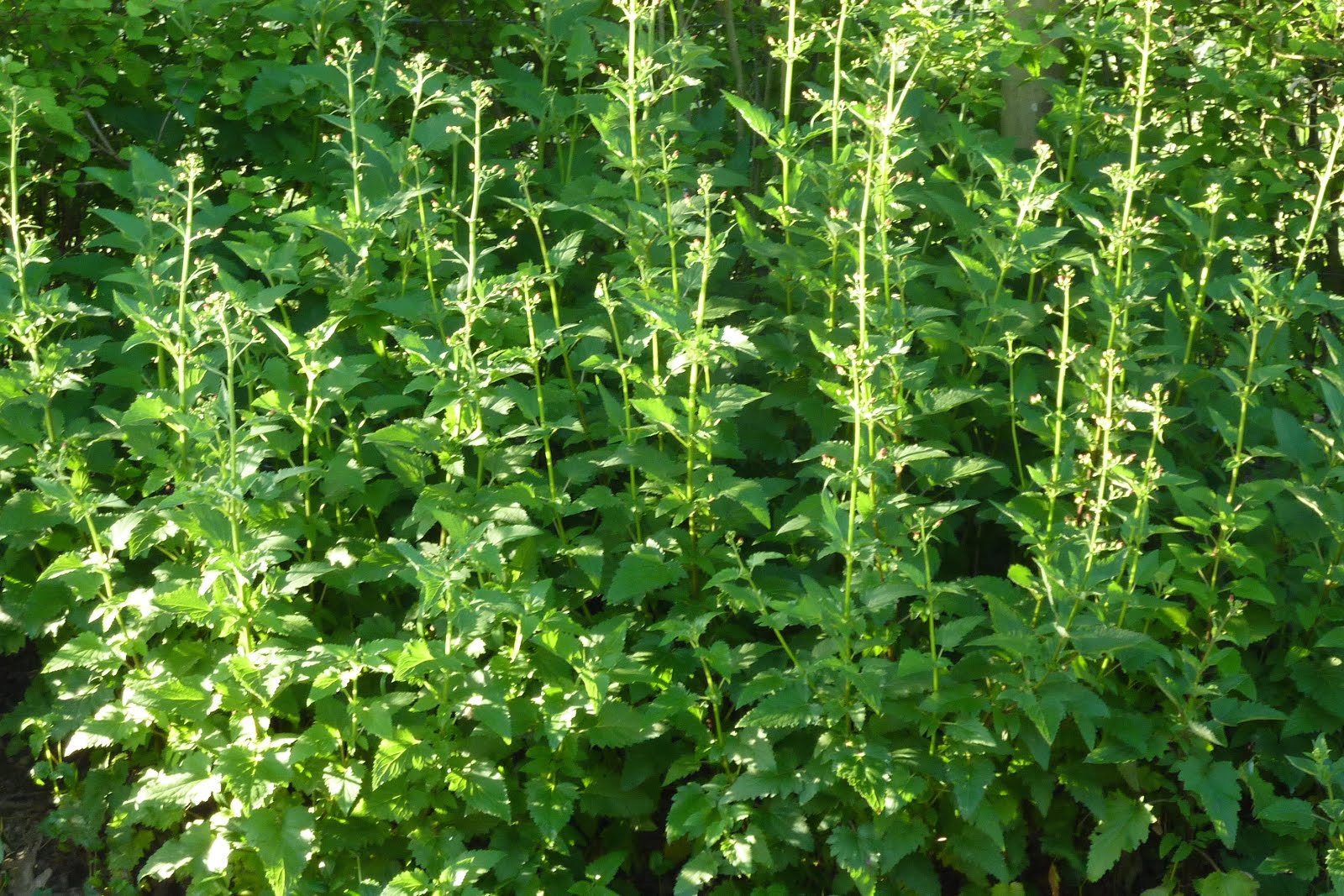
And in the early morning as the sun rises when I am sitting, I often see a hummingbird sipping nectar from the diminutive flowers on this figwort. I have seen insect pollinators on the flowers but I had not observed hummingbirds. 

Bee Plant, so named because bees, native or nonnative, 
adore this vigorous native plant with small maroon flowers
or, in other arenas, called Figwort (Scrophularia californica).


During this glorious Spring may we all weed and 


Saturday, April 2, 2016

Thriving

Five eggs from five MuRefuge's ducks.
Perhaps not impressive in numbers when each duck lays one eggs a day. However, it is impressive when one considers the age of the duck laying the egg. MuRefuge's oldest female Fawn and White Indian Runner was nine, yes nine, last month. The second oldest, a chocolate Indian Runner, will be seven in a few weeks. The blue Indian Runner will be four next month. And the youngest two, the Tootsie Rolls, were a year old early last month.

This is the second morning this week I have gathered five eggs from the nesting boxes when I let the ducks out of their house. I am grateful and astounded that The Crone, the oldest female, is producing an egg. 

Obviously, these residents of MuRefuge are not just surviving here but thriving. They all forage each day, scarfing up bugs or any other kind of creepy crawly from their duck yard then clamor at the veggie garden gate to be let out into the backyard. With Shasta safely inside they cover the entire expanse foraging for protein. The number of snails and slugs that can be found on the entire three quarters of an acre does not even cover the bottom of a yogurt container. When we first got ducks, I gathered a full container almost every morning, carrying the container to the flock and emptying it in front of them. In a nanosecond all the snails seemed to magically disappear.

As each of us identify what supports our individual thriving, may each of us