Western wild ginger, along the back, was recently transplanted from Shasta's Auntie T's garden. The large piece of green pottery was made by Dwight and filled with "pretty" rocks. It sits beneath the butterfly rain chain which is attached to a rain downspout.
In the creating the two native habitats in previous homes I was a stickler for using only natives: a purest attitude, so to speak, of only natives. Since living in Santa Fe, New Mexico, and falling in love with some of the natives in that part of our country, my stance of having an unadulterated garden of natives has now been relaxed. I so miss living in Santa Fe, so to abate some of the grief I am bringing some of Santa Fe to my gardens here in Cotati.
In the 1980's when visiting Apple Valley, California, I saw a Desert Willow in bloom. I fell in love with the gorgeous flowers. This tree is native to the desert Southwest so many thrived in the Santa Fe area where we lived. Plants of the Southwest had these in 5 gallon containers. I bought and planted two; one was planted just outside of our 1950's Stamm home's sliding backdoor.
September 06, 2020 The Desert Willow "bush" planted outside our sliding backdoor.
Close up the flowers. This is a cultivar.
December 30, 2020 Desert Willow pruned to be a tree.
The second one was planted outside of the double black wrought iron gate near the adobe wall. These trees grow pretty quickly so after the first year, there were flowers. I have planted two on the West side of our house here in Cotati. These two were much smaller than those purchased at the Plants of the Southwest so I am not holding my breath for the glorious blooms!
Picture taken on May 29, 2018, at the Indian Pueblo Cultural Center, Albuquerque, New Mexico. These native tree blossoms are paler. The flowers on the tree planted outside of the wrought iron gate are this color. Notice the seed pods, so like that of the Catalpa tree
The other nonnative plant now flourishing in the back yard near the finch feeder is Rocky Mountain Penstemons. I planted about a dozen of them in our front yard in Santa Fe. In the Fall the tall seed stocks were covered with goldfinches hoping up and down the seed stocks scarfing up all the tiny black seeds. Since we have a plethora of goldfinches coming to their feeder filled with nyger seeds, I thought they might delight in penstemon seeds too?
Rocky Mountain (Penstemon strictus)
and
Chocolate Flower (Berlandiera lyrata)
pictured above flowering in June of 2020 at
the San Felipe Circle native habitat.
I have seeds on order from Plants of the Southwest. I plan to germinate a few of the seeds so I can grow these Chocolate Flowers. Yes indeed the flowers smell like chocolate.
Since Dwight enjoys Japanese maples and one is growing in our front, I decided to leave it. During the Winter months it is especially wonderful to look out and see the stunning red branches. These made a stunning backdrop for holiday lights and straw ornaments tied on with red yard.
The tall, and I mean tall, hedge (pictured above) along the Eastern side of our back patio blocks people living in the apartments next door from seeing into our back yard and library. My intention when we moved in was to remove this hedge. Friends who visit and sat at our patio table for meals vociferously voiced, "leave it." So leave it I have. I am now grateful that I listened to such sage advice.
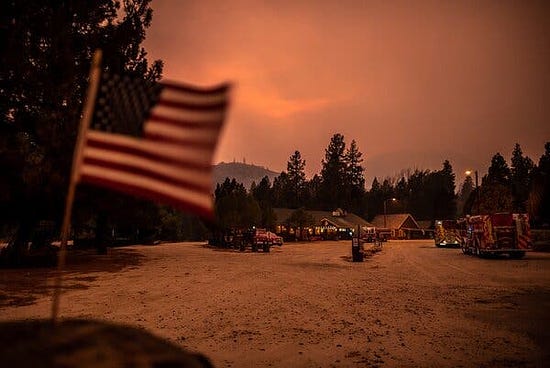
This below helpful perspective arrived this morning in my email. I thought I would share it here for anyone who might be thinking "I just want my life to be back to normal" i.e. like it was before the pandemic, before the massive wildfires raging in the West, before the mirage of global alterations brought on by climate change, etc.
“I met with Alex Steffen, a climate futurist, on the back patio of a bar in Berkeley. Steffen, a 53-year-old mountain of a man with a crystal-ball-bald pate, hosts a podcast and publishes a newsletter called The Snap Forward. The idea behind both is that the climate crisis has caused us to get lost in time and space; we need to dig ourselves out of nostalgia and face the world as it exists. As he explained to me in his confident baritone, yes, California, and the world, are in bad shape. But the situation is not as devoid of hope as we believe. ‘We have this idea that the world is either normal and in continuity with what we’ve expected, or it’s the apocalypse, it’s the end of everything — and neither are true,’ he said. That orange sky in 2020? ‘We’re all like, Wow, the sky is apocalyptic! But it’s not apocalyptic. If you can wake up and go to work in the morning, you’re not in an apocalypse, right?’
The more accurate assessment, according to Steffen, is that we’re ‘transapocalyptic.’ We’re in the middle of an ongoing crisis, or really a linked series of crises, and we need to learn to be ‘native to now.’ Our lives are going to become — or, really, they already are (the desire to keep talking about the present as the future is intense) — defined by ‘constant engagement with ecological realities,’ floods, dry wells, fires. And there’s no opting out. What does that even mean?
We’re living through a discontinuity. This is Steffen’s core point. ‘Discontinuity is a moment where the experience and expertise you’ve built up over time cease to work,’ he said. ‘It is extremely stressful, emotionally, to go through a process of understanding the world as we thought it was, is no longer there.’ No kidding. ‘There’s real grief and loss. There’s the shock that comes with recognizing that you are unprepared for what has already happened.’
I found Steffen’s sweeping, dark pronouncements comforting. He at least had language and a functional metaphor to describe what was going on. Most of us have dragged our feet and deluded ourselves for too long about the state of the world. While we remain stuck, our world pulled away from our understanding of it. We’ve now fallen into a gap in our apprehension of reality. We need to acknowledge this, size up the rupture, then hurl ourselves over the breach.
As we sat there, the bar’s concrete patio filled up with young, busy people and their laptops, their gatherings part of an endless stream of work meetings displaced by the pandemic, individuals trying to make the shapes of their lives as ‘normal’ as possible — the whole premise of which, Steffen argued, was a mistake. The mind-set locks us into defining ourselves as the trapped inhabitants of someone else’s broken world.
Relinquishing the idea of normal will require strength, levelheadedness, optimism and bravery, the grit to keep clinging to some thin vine of hope as we swing out of the wreckage toward some solid ground that we cannot yet see. ‘We’re no longer dealing with a fire regime in the woods that responds to the kinds of mild prevention and mild responses, the sensible responses we have thought about, and that thought alone is a crisis,’ Steffen said. ‘It means the lives we had we no longer have.’
…
Across California — across the world — it’s easy, even comforting, to sit in despair. To stay depressed and mired in a state where not that much has truly changed. But nihilism is a failure of imagination, the bleak, easy way out. We need to face the lives before us. We need to name the discontinuity: See, there it is, the tear in the universe created by our fear and greed. What we believed was the present is actually the past. That was Steffen’s message to me in the Berkeley bar. We failed to keep pace with the future.”
It’s a great piece, and you should read the whole thing. I can’t complain at all, either, about how my ideas are described and used to frame the story. And lots of people have already found my work because of the piece’s prominence — including about 1,000 of you who are new subscribers — welcome! [Pro tip: If you’re a paying subscriber, start listening to the podcast series at the beginning, since each builds on the last.]
All of which is fantastic.
I have, however, been getting lots of questions about these ideas and what they mean, and I’m seeing people start to wrestle with the complexities of discontinuity, transapocalypse, ruggedization, and the Snap Forward itself.
Long-time readers — especially paying supporters who’ve been listening to me ramble on in the podcasts — probably feel familiar with these ideas, so forgive me if some of this is recap, but I thought I’d lay down a few quick guiding thoughts to help clarify things.
First, though this story is about California — and that was the specific focus of the conversation Liz Weil and I had last summer — the changed realities Californians find ourselves facing are different only in their specifics from the challenges people all around the world now face. California may get a lot of press for its fire tornadoes, atmospheric rivers, ocher skies and crumbling seaside cliffs. It may even have become some sort of shorthand for imminent destruction. Nowhere else is much better off, though. Ask not for whom the klaxon bell rings, dude, because we all live in California, now.
Second, the reason why the planetary crisis is not an issue, but an era, is that we find ourselves living within a human world we’ve built, on a natural planet we’ve radically altered, and as we’ve driven planet-scale transformations through the climate and biosphere, our human world is increasingly unstable. The core challenge facing humanity is the need to rebuild the places, systems and societies around us to work on the planet we now inhabit. Every other problem we’re struggling with is subsumed under this overarching reality. There is nowhere to stand outside of it.
Billions of us will collide with this fact in the next few years. The suddenness of our understanding of this reality — a reality that’s been solidifying for decades, but that a combination of predatory delay, entrenched entitlement and cultural inertia have kept us from seeing — means that our sense of tempo is shot to hell. Enormous changes will now come very fast.
As I wrote before,
“A big problem in thinking about discontinuity is that the first step is the longest one: embracing the idea that things can change at scales and speeds that render suddenly obsolete and unstable much of what we still assume is normal, valuable, and durable.”
Third, the planetary crisis ain’t the Apocalypse. We do not face the End of Everything. We face the obliteration of our certainties, sure. We also face the destruction of many of the wonders of nature. And we face the reality that for billions of people, life will feel pretty damn apocalyptic, even as humanity as a whole staggers along. We live now in a transapocalyptic world.
This changes what we might think of as right action in this moment. We are not the ones who are going to save the world by keeping the planetary crisis from happening, because it is already in motion, with more to come. There’s this line from 'No Country for Old Men' that I can’t get out of my head: "You can't stop what's coming. It ain't all waiting on you. That's vanity."
We are not now capable of designing a future that works in continuity with our existing systems and practices while producing emissions reductions and sustainability gains fast enough to avoid truly dire ecological harm. This is an option that no longer exists.
Fourth, we’re all waking up in the Snap Forward. We are, in increasing numbers, coming to realize that not only is the world already profoundly different than we thought — a rupture with our past — but that over the next few decades, the world will depart even more wildly from what we still think of as normal.
Discontinuity is the job for those of us who want to succeed with purpose, to have our own aspirations connect with strategies to deliver new solutions at the scope, scale and speed reality demands.
Discontinuity is also the job, though, for billions of people who are more concerned with their own selves, families and communities than with the fate of the Earth. People acting from necessity — from the need to secure themselves from danger, to seize the opportunities to be found in rapid change before others can, to find cohesive constituencies who are ready to move with the speed demanded — are going to change our society far more in the near term than even the massive ecological dangers unfolding in front of us. Indeed, a core part of the Snap Forward is recognizing that people responding to discontinuity have become the dominant force of change on the planet:
“[What’s coming is] a realization that large-scale actions are now being driven not primarily by collective agreement of all parties, but by the growing power of those who see fast action as not only being in their self-interest, but also to their direct advantage.”
None of this is under control, much less optimal, but that’s what happens when you melt the damn ice caps.
Nor is it all bad, at all. We don’t take the planetary crisis seriously enough, but we completely fail to grasp that we’re experiencing not just discontinuity but a massive transformation in the shape of the possible. It is not too late for humanity to find a future that’s brighter than the present, but it won’t happen because we all agree on what it should look like. Nothing is that simple, or linear, or collective, or predictable anymore.
Fifth, it’s important to live when we are. Being native to now, I think, is our deepest responsibility in the face of all this. And being at home in the world we actually inhabit means refusing to consign ourselves to living in the ruins of continuity, but instead realizing we live in the rising foundations of a future that actually works. It may be a fierce, wild, unrecognizable future, but that doesn’t mean it’s a broken future. Indeed, it’s the present that’s broken beyond redemption.
When it comes down to it, humanity’s discontinuity is made up of billions of personal discontinuities. Facing our own discontinuity forces the reality of changes that we desperately want to think of as “out there” into our own work, our own lives, our own homes, our own hearts. Even this, though, can be liberating.
That’s what we’re here to talk about: liberating, in this new reality, the best possibilities of our selves, our solutions and our societies from the dusty, decrepit certainties of a predatory past. Succeeding in every sense.
If that sounds good to you, you’re in the right place.
Yours in discontinuity,
Alex
And while we mull over the above "helpful perspective" may we each
May we realize that this earth is sacred and live accordingly. May the suffering arising from oppression, hatred, and fear be righted and remedied. May all those in the grips of insecurity be released to the safety of understanding. May those weighed down by grief be given over to compassion. May those lost in delusion find relief in the path of wisdom. May all wounds to forests, rivers, deserts, oceans, all wounds to the earth be witnessed and healed through our right action. May we work for the ending of suffering from consumerism, the climate catastrophe, war, economic disparity, racism, sexual violence, and the abuse of children. May those in refugee camps and prisons find their way home, with our support. May those who are alone or abandoned by friends and family, and those who are unsheltered find a safe and loving harbor in community. May we give ourselves time for practice with each other and in the solitudes, to be taught by sangha and by silence, so that we have the courage and equanimity to be a source of love and wisdom for all beings. May we all have the health, wisdom, and energy to serve in the years ahead. May all awaken and awaken others.
And may each and everyone of us as we enter this new year (where???? did 2021 go???) partake throughout the year in a frequent cleansing
We do not speak, because the voices are within us.
It is our quiet time.
We do not walk, because the earth is all within us.
It is our quiet time.
We do not dance, because the music has lifted us
to a place where the spirit is.
It is our quiet time.
We rest with all of nature.
We wake when the seven sisters wake.
We greet them in the sky over the opening of the kiva.”
NANCY WOODS
Although I am not a fan of persimmons to eat, I am ever so pleased by these "nature's ornaments" adorning bare trees. They are as beautiful, perhaps more so, than any holiday ornaments created by humans. Walking about our neighborhood one notices these trees with her stunning luscious orange ornaments. How could one not?
Winter Solstice greetings to each of you wondrous BEings as we negotiate, once again burgeoning COVID-19 cases. The culprit this time is the highly contagious Omicron variant of the virus.
We all are asking how to celebrate the holidays in the safest way possible. I hear of so many cancelling previously made plans to fly for gathering with distant family members and friends, and questioning when will each and every one of us be free to resume our once previously familiar lives. From my perspective I am highly doubtful that will happen any time soon, if ever.
Sporting events as well as other events happening in big spaces are either having the number of attendees radically decreased or events halted altogether. The Warriors, my very favorite basketball team ever, recently sent home their top players to avoid a possible detainment in Canada related to COVID. WHEW! The entire team is now back together in San Francisco. They are ready to play in their own Arena for two games before hitting the road again.
The predictions are that the virus will hang around well into 2024.
Me . . . I think each of us individually might as well figure out how to live as safely as possible with this virus. And now "at this quiet time" go inward for rest. ZOOM for family and friend connections if one want to BE with others. If one is with others, wear double masks and social distance. Where have we heard this before?
And perhaps the singularly most valuable tool is frequently engaging in a whole hearted belly
Solstice, Yule: the longest night and shortest day approaches. We have entered into the darkness, but just as it grows to its greatest extent, the light is reborn. This is a time to celebrate all that warms us and gives us hope. There is much reason to hope and celebrate, as well as so many reasons to feel pain right now.
These are times of extremes, but Solstice reminds us that the greatest darkness contains the seed of light—as, on the opposite pole of the year, the triumph of light begins the descent toward the dark.
The world is dynamic, not static; the wheel is ever-turning."
It is the time of the year to naturally go inward. The Winter Solstice is also an opportunity to joyfully celebrate.
Dwight and I joyfully decorating the Japanese maple tree that has shed her leaves, leaving bare red branches which invite holiday decorations and lights. Leigh, who was here visiting from Seattle, and Dwight put up lights. Above, we are hanging the straw ornaments I purchased on the San Antonio, Texas, Riverwalk when my parents were visiting from Iowa.
One way to begin this season is to turn one's attention to his/her body. The below practice of turning the mind toward the body by Joan Halifax is one way of doing so.
"Turning the Mind toward the Body
Do this practice laying down, sitting on a meditation cushion or a chair.
Breathe deeply into your belly, letting your body feel open and safe.
Now bring your attention to your scalp.
As thoughts arise, just let them be.
Move your attention to your temples and forehead.
As you breathe in, let your temples and forehead feel open and soft.
Breathe into your eyes and let them soften.
As you breathe out, let go of all hardness in and around your eyes.
Bring awareness to your ears.
Breathing in fully, open your ears.
Exhaling, feel grateful for being able to listen and bear witness.
Bring your awareness to your mouth.
On your inhalation bring a slight smile to your mouth.
On your exhalation feel yourself letting go of any tension in your face.
Gently move your awareness to your throat and neck.
Breathe into your neck and throat and breathe out gratitude.
With your awareness on your shoulders, breathe into your shoulders, letting go of any burdens you might be carrying.
Let your awareness be in your arms and hands.
There is nothing that you need to hold on to.
Shift your awareness to your spine, letting it stretch with your inbreath.
Feel the strength of your spine on your outbreath.
Bring your attention to your chest and lungs.
Breathe deeply into your lungs.
Now breathe into your heart and be aware of any tightness in and around your heart.
Feel your heart open, as it trusts your attention and your breath.
Bring your attention to your stomach, bowels, bladder, and reproductive organs.
Give your entire pelvic area a feeling of space and ease.
Be aware of your legs.
Breathe into your legs as you settle your attention into them.
Breathing out, let your legs soften.
Breathe into your feet, aware of any tension in your feet.
To complete this practice, slowly, gently, and smoothly bring your awareness from your feet to your legs; to your pelvic area; to your chest, heart, and lungs; to your spine; to your shoulders, arms, and hands; to your neck; to your face; to the top of your head.
Breathe in and out smoothly as your awareness travels up and through your body.
When you have reached the top of your head, return your awareness to your breath, then let it gently spread to your whole body.
Take a few moments to relax with an open and quiet mind."
In the distant past, while attending gi gong practice in San Francisco, we also engaged in this movement to shift our attention from outward directed to inward. Cathie's teachers, Charlotte and Da-Jin Sun, now reside at their Daoisthermitage located in Moscow,Idaho. We are exceptionally grateful to them for our two month long, life changing trips to China with them.
Sunrise at Bosque del Apache viewing the take off of the Sandhill Cranes in search of food throughout the Middle Rio Grande Valley.
Another way to celebrate with joy is to venture out into the wilds. Here we can often experience the joy of other living BEings. Above is a picture we took when doing so while living in New Mexico. At Bosque del Apache, a National Wildlife Refuge near San Antonio, New Mexico, one can feast one's eyes on upon thousands of Sandhill Cranes who spend their nights in the water to protect themselves from predators. Before our extended (almost 4 years) "vacation" in Santa Fe, we had gone to the Central Valley in California to view the Sandhill Cranes. While seeing the cranes was exciting, the setting was not nearly as spectacular as that near San Antonio. I feel immense joy just remembering the outing with my husband and I and Shasta, who of course had to stay in the car so not to scare the resting birds.
This year, as had been our tradition before living in Santa Fe, we went into the National Forest North of Bridgeport, California on our return home trip, to cut our Yule tree and a small one for Auntie T as well. The picture above shows Dwight securing the trees on the roof rack as Shasta enjoys the smells of the high Sierra Mountains desert.
Our small by previous standards but gorgeous Pinyon Pine is decorated as you can see in the night time picture below. The tree's luscious smell wafts through our home . . . delicious for many senses!
And may we all find time to rest for deep rejuvenation for each and everyone of us. Shasta is such a good model of resting as the picture of her below in her doorless crate demonstrates:
As we all frequently get caught up in the dither of the holiday season, may we take time for a cleansing of our emotions with a